What you can legally do yourself
Under UK common law, property owners have the right to cut back overhanging branches or roots to the boundary line without requiring permission from the tree owner. This fundamental principle means homeowners can take action themselves when trees encroach onto their property.
However, there are important limitations. The work must be carried out entirely from your own land without trespassing onto the neighbour's property. Any branches or roots you cut remain the property of the tree owner and should be offered back to them.
James Naylor, a partner at Naylor Solicitors LLP, explained the concept using a helpful analogy:
A boundary, in theory, runs down to the centre of the earth and up to the sky. It can be helpful to picture it as an invisible vertical line separating one property from another, like a precise line with no thickness or width. Imagine a laser beam projecting vertically upwards from the boundary.
If a branch crosses that invisible line, the neighbouring owner is generally entitled to cut it back to the boundary without first obtaining permission and without any obligation to give notice.
Why councils don't have to act
There is no general legal duty on a tree owner to prune a tree simply because it overhangs a boundary, sheds leaves, or reduces sunlight. A legal duty to act only arises when the tree is causing or is imminently likely to cause actionable damage or nuisance.
This explains why the council in this case can refuse maintenance requests based on budget constraints. Without evidence of actual damage to the property, they have no legal obligation to trim the trees regardless of how much they overhang or cast shade.
Joanne Ellis, a partner at Stephensons, noted:
Frustrating as it may be, there is generally no legal obligation for a landowner to prune or reduce the height of trees simply because they cast shade or have become larger than neighbouring residents would like.
Understanding willow tree growth
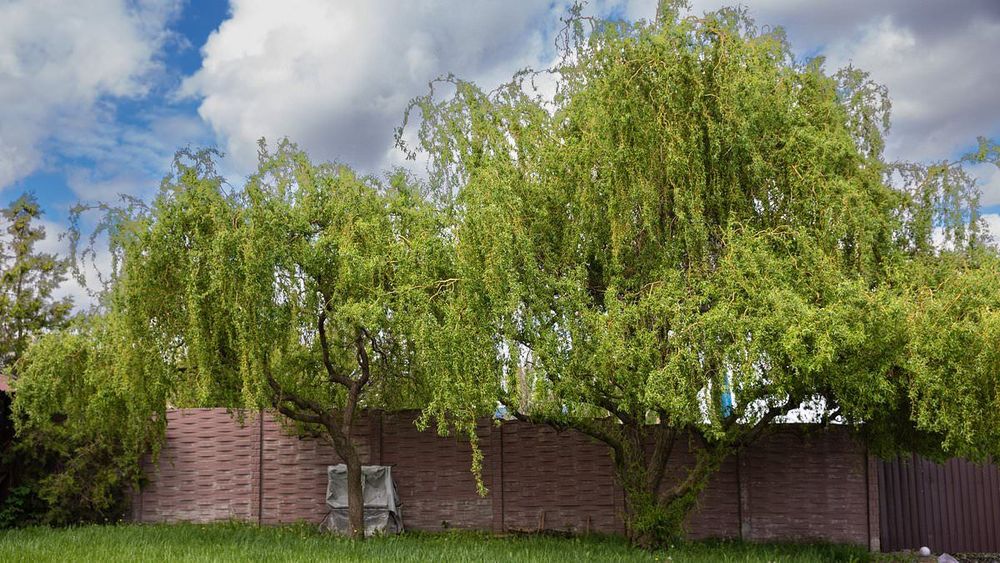
The rapid escalation of this particular problem is partly explained by the nature of willow trees themselves. These fast-growing species can add between 3 to 10 feet of height annually under optimal conditions. Weeping willows can reach heights of 50 to 70 feet at maturity, with canopy spreads of 30 to 50 feet.
According to the Royal Horticultural Society, willows can grow up to about eight metres wide and 12 metres high, making them suitable primarily for larger gardens. This vigorous growth pattern means that without regular maintenance, the trees quickly become problematic for neighbouring properties.
What about high hedge legislation?
Some homeowners wonder whether high hedge legislation under the Anti-social Behaviour Act 2003 might provide a remedy. However, this legislation has specific requirements that often don't apply to individual trees.
High hedge legislation defines a 'high hedge' as a line of two or more evergreen or semi-evergreen trees or shrubs over 2 metres in height that blocks light or access. Individual trees, regardless of their height, do not qualify under this legislation.
Even if the trees did qualify, pursuing a high hedge complaint involves fees that vary significantly across local authorities, ranging from £250 to £851. Councils typically require evidence that complainants have attempted to resolve the issue themselves for at least three months before accepting a complaint.
Critical warnings before taking action
Before cutting any overhanging branches, homeowners must check whether the trees are protected by a Tree Preservation Order (TPO) or located within a conservation area.
TPOs make it a criminal offence to cut, prune, or damage a protected tree without written council consent. The penalties are severe: fines can reach up to £20,000 in Magistrates' Court or be unlimited in Crown Court. Council consent applications are free and must be decided within 8 weeks.
In conservation areas, any work to trees over 75mm diameter at 1.5m height requires 6 weeks' written notice to the council, even without a TPO. Wildlife legislation must also be complied with, particularly regarding nesting birds and protected bats.
Naylor emphasised this point:
I am assuming that the trees are not subject to a Tree Preservation Order and are not located within a conservation area. Trees protected by a TPO will generally require the local planning authority's consent before pruning works are carried out, while works to trees in a conservation area generally require prior notice to the authority.
When wider remedies may be available
If trees are causing actual physical damage to property, wider legal remedies may be available beyond the basic right to trim to the boundary. Court intervention could potentially be sought, though proceedings are likely to involve considerable time and expense.
For concerns about fire risk or safety hazards created by lack of maintenance, Ellis recommended submitting a formal written complaint to the council:
The council, as a landowner, has a duty to take reasonable steps to manage foreseeable risks arising from its land.
She advised asking the council to explain the basis on which it has assessed the risks posed by the trees. If that does not resolve the issue, legal advice can be sought to assess whether there are grounds for action based on nuisance or safety concerns.
The bottom line
While councils may own trees on their land, once branches cross the boundary line they lose some control over them. Property owners can trim overhanging growth to the boundary, provided they work from their own land and comply with TPO, conservation area, and wildlife protection requirements.
However, homeowners cannot force councils or any other neighbour to maintain trees simply because they overhang, cause shade, or drop leaves. Without evidence of actual damage or imminent risk, the legal system provides limited recourse beyond self-help remedies.
As one expert put it:
The council may own the tree, but its branches do not acquire squatters' rights over your garden. Once they cross the boundary, they are generally fair game for the secateurs.