The gaps between systems
Larger completions programs, with more stages on each well and more wells on each pad, have increased pressure to meet schedules and budgets. The industry's response has emphasized greater pumping capacity, more powerful equipment and quicker stage execution. TechnipFMC says those advances have made surface systems more reliable, while automation and better monitoring and controls have reduced manual work.
Yet equipment can operate correctly while the wider job stalls. TechnipFMC identifies handovers, transitions and points requiring intervention as more likely sources of disruption than component failures in these interconnected operations. A valve that actuates late, a change to the surface configuration or a sequence of manual tasks can hold up work elsewhere on the pad.
As well counts, stage counts and concurrent activities grow, more dependencies must be coordinated before work can proceed. The company's argument is that reliability therefore needs to encompass the entire sequence of operations, rather than just the performance of its individual parts.
How much time transitions can take
A technical article in The American Oil & Gas Reporter illustrates the time involved. It puts average transition time between wireline and fracturing operations in traditional plug-and-perf completions at 20-45 minutes per stage, depending on surface tools such as latches and zipper manifolds. Frac iron must undergo depressurization, pressurization and pressure testing at every stage.
The publication also describes Primexx Energy Partners' use of a fully automated plug-and-perf completion system developed with SEF Energy's Downing brand. The deployment covered 34 horizontal Wolfcamp wells in the southern Delaware Basin, completed from August 2018 through February 2020.
The first nine wells averaged 10,000-foot laterals and 50 stages apiece. Average wireline transition time dropped 90% to three minutes, while the completion rate increased from 30.5 feet per hour on prior wells to 37.3 feet per hour. Following the addition of an automatic lubricator fluid pump, the next 14 wells achieved 42.2 feet per hour, 38% above the original baseline.
Measuring whether work keeps moving
For campaigns that repeat the same processes hundreds of times in rapid succession, TechnipFMC proposes operational continuity as a more useful yardstick than equipment performance alone. That approach focuses on avoiding pauses in productive work, not merely keeping machinery available.
The company identifies several shared features of operations with high continuity: fewer manual checks and interventions, less dependence on separate systems, consistent procedures across wells and stages, and a clear view of activity throughout the operation. It also calls for keeping equipment maintenance off the critical path. These changes do not make individual components more reliable, it says; they reduce the occasions when the overall operation must stop.
TechnipFMC says this approach could make schedules more predictable, improve consistency across stages and pads, and help operators use crews and equipment more effectively. It could also improve coordination among service providers, systems and workflows. Adopting continuity goals, the company suggests, may prompt operators to reconsider how they design workflows, manage handovers and integrate systems.
Pumping-hour gains reported with iComplete
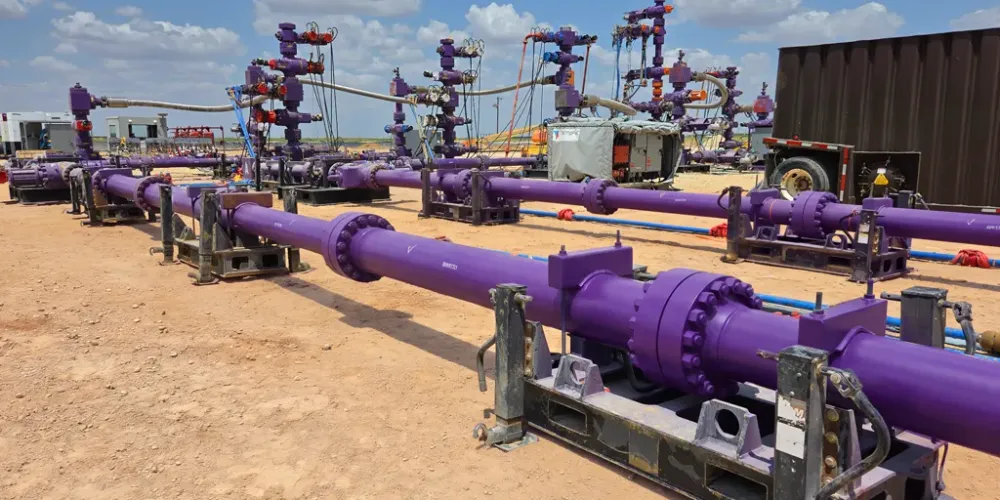
TechnipFMC presents its iComplete high-performance surface pressure containment ecosystem as an application of that approach. The company says its combination of autonomous operations, proactive maintenance and remote monitoring has improved efficiency, cut downtime and supported safer, more consistent completions.
In one case study, TechnipFMC reports that a major unconventional operator increased average monthly pumping hours by more than 30% after deploying iComplete. Pumping totaled 594 and 635 hours in the first two months, compared with approximately 405 hours per month before deployment. Average daily pumping hours increased from 17.8 to 21.8.
The company attributes those gains to remote operations, automated stage transitions and proactive pump-bank isolation through its HyperFrac modular missile system. It says the automation eliminated the typical five-minute interval between stages.
High-rate pumping and surface connections
A separate TechnipFMC case study concerns a Permian Basin operator seeking to maintain at least 90% pumping efficiency during high-rate, sand-laden pumping. The company reports that replacing traditional manual frac operations with iComplete increased time spent pumping under those conditions by 20%, without additional pump horsepower.
TechnipFMC says the deployment also eliminated wireline cuts during fracturing. Sensors in its Speedloc-XT digitized hydraulic connector detected wireline and prevented valves from closing when it was present.
For surface connections, the company says PadFlex, its high-pressure flexible pipe technology within iComplete, requires approximately 90% fewer connections than conventional approaches and enables 50% faster makeup time. The technology allows connections across multiple wells and pads without physically moving heavy equipment, according to TechnipFMC.