
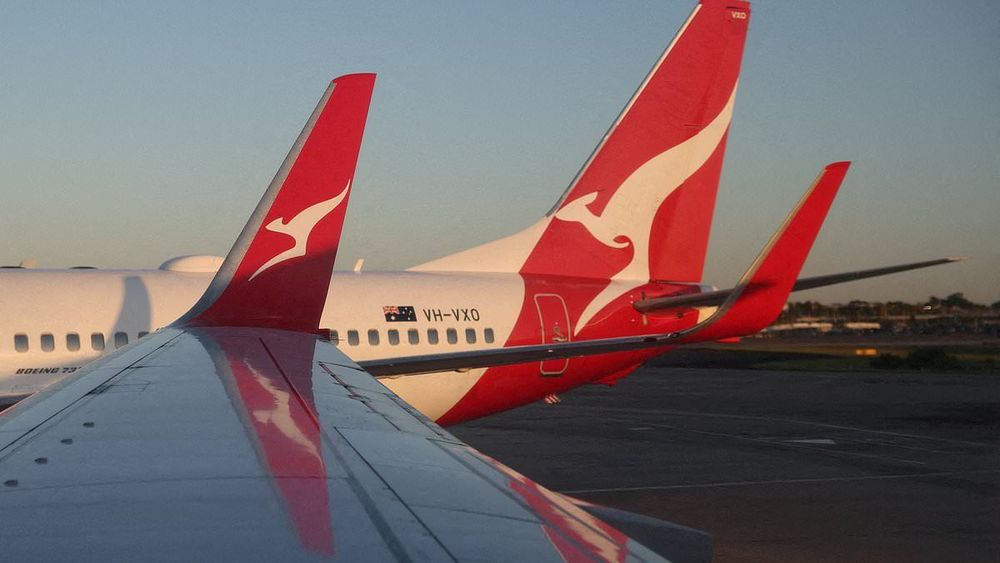
Sydney Airport chaos as 95 flights delayed up to two hours in operational crisis
Tens of thousands of passengers faced significant disruptions at Sydney Airport on Friday morning after at least 95 flights were delayed or cancelled due to operational issues, marking another setback for Australia's busiest aviation hub.
The situation, first flagged on tracking site Flightradar24 early Friday, saw Qantas suffer the heaviest impact with more than 50 flights delayed and four services cancelled. Some aircraft remained grounded on the tarmac for up to 120 minutes, while Virgin Australia reported approximately 20 delayed flights with two Melbourne services cancelled. Jetstar confirmed 25 services were also affected.
Sydney Airport, which handled more than 42.54 million passengers in 2025 including a record 17.17 million international travellers, is on track for its busiest year ever for international travel in 2026. The disruptions come at a particularly inopportune time, with 12.55 million international passengers already recorded in the first nine months of this year.
Rex Airlines reported that passengers had to be offloaded from aircraft and transported back to terminals by bus. One woman scheduled to depart for Cairns at 6.10am described taxiing for approximately 30 minutes before returning to the gate.
I was wondering what was going on because we hadn't taken off yet. Then we got an announcement saying there's something wrong with the radar and also the backup radar wasn't working as well.
Another passenger bound for Hong Kong reported a departure delay of one-and-a-half hours attributed to air traffic control issues.
Pattern of recurring problems
The Friday disruption represents the latest in a series of operational challenges at Sydney Airport. In January 2026, staff shortages led to four days of significant service disruption and the cancellation of over 50 flights, raising concerns about systemic issues affecting Australia's primary aviation gateway.
Stephen Beckett, chief executive of Airlines for Australia, which represents most major carriers, described Friday's situation as "catastrophic."
Tens of thousands of Australian travellers will have their commute impacted by this – they will miss international connections. This is catastrophic for the national network – we need to know what is going on.
Beckett noted that Airservices Australia, the government-owned corporation responsible for managing air traffic across 11 percent of the world's airspace, needs to ensure adequate staffing and robust rosters. "This is a persistent problem that Airservices says they have fixed," he added.
Official response and context
Airservices Australia confirmed it had enacted Air Traffic Flow Management measures at Sydney Airport on Friday morning. ATFM is a strategic system designed to balance air traffic demand against available capacity by managing aircraft flow to prevent airports and airspace from exceeding safe operational limits.
"Airservices this morning enacted Air Traffic Flow Management measures at Sydney Airport due to operational restrictions to safely manage projected airborne and departure demands," a spokesperson said. The organisation acknowledged the measures caused disruptions to airline scheduling but stated that capacity had been restored and no further significant delays were anticipated.
The disruption comes despite recent improvements in the aviation network's performance. In May 2026, the Australian aviation network recorded no Airservices-attributable ATFM ground delays at the four major airports, while airspace service variations were 18 percent lower than May 2025.
Airservices Australia has been working to address staffing challenges, having endorsed 91 additional air traffic controllers in 2025, exceeding its target of 85. The organisation aims to endorse another 95 controllers in 2026.
The spokesperson emphasised the professionalism of air traffic controllers:
Airservices air traffic controllers are incredibly proud and dedicated to performing what is a demanding, safety-critical role. We take their wellbeing and psychosocial safety seriously and ask that commentary on operational performance recognises the professionalism and commitment of the controllers working every day to keep the travelling public safe.
Sydney Airport operates under a legislated curfew between 11pm and 6am, with most aircraft operations prohibited during this period except for emergency aircraft, some small jets, propeller-driven aircraft and freight movements. This operational constraint can amplify the impact of delays by limiting the airport's ability to recover during overnight hours.
Looking ahead, Western Sydney International Airport, a new 5.3 billion dollar aviation hub located 41 kilometres west of the CBD, is scheduled to open in late 2026 and will operate 24/7 without curfew restrictions, potentially alleviating some pressure on Sydney's main airport.