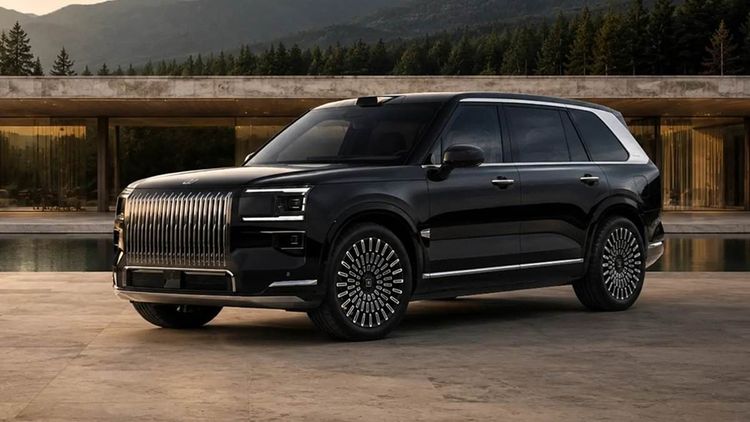
Range Rover unveils electric GT saloon in historic departure from SUV heritage
Range Rover has taken the wraps off its most radical model yet: an electric grand tourer that abandons the brand's signature high-riding SUV format for sleek saloon proportions. The GT represents the first time in Range Rover's history that the British marque has produced a vehicle without elevated ground clearance and traditional SUV styling.
Since the original Range Rover was unveiled to the press in Cornwall on 17 June 1970 — a vehicle so groundbreaking it was displayed in the Louvre as an example of industrial design excellence — the brand has built its reputation exclusively on luxury sport utility vehicles. The GT breaks that 56-year tradition.
Heavily camouflaged prototypes reveal a low-slung profile that resembles a Range Rover Sport compressed vertically, creating what the company describes as a 'captivating new expression' of the brand. The vehicle is similar in length to the current Range Rover Sport but features dramatically reduced overhangs front and rear to maintain off-road capability.
Competing with Jaguar's controversial reinvention
The GT's arrival creates an unusual competitive dynamic within Jaguar Land Rover's portfolio. Under the company's 2023 'House of Brands' strategy, Range Rover, Defender, Discovery and Jaguar were repositioned as distinct marques targeting different customer segments, with Range Rover established as the luxury brand and Jaguar transitioning to electric-only luxury positioning.
Yet the Range Rover GT appears set to compete directly with Jaguar's forthcoming Type 01, an electric four-door GT priced from around £120,000 to over £150,000 for high-specification versions. The Jaguar, scheduled for unveiling in New York in October 2026, is built on the bespoke Jaguar Electrified Architecture platform and delivers over 1,000 PS from a tri-motor setup, targeting a range of up to 478 miles with ultra-fast charging capability.
While proportionally different and underpinned by distinct platforms, both vehicles aim at the luxury grand-touring segment, raising questions about potential market overlap between the sister brands owned by India's Tata Motors since its 2008 acquisition from Ford.
£500 million factory transformation
The GT will be manufactured at JLR's Halewood factory in Merseyside, which has undergone a £500 million transformation for electric vehicle production. Originally built in 1963 to produce the Ford Anglia, the facility has been extended by 32,364 square metres and equipped with 750 autonomous robots to build mid-sized electric luxury vehicles.
Underpinning the GT is JLR's Electrified Modular Architecture platform, featuring an 800-volt electrical system with ultra-fast-charging capability. Initially designed exclusively for battery-electric vehicles, JLR confirmed in June 2026 that the platform will now also accommodate full hybrid powertrains to provide greater flexibility — addressing concerns about pure-electric vehicle demand.
This differs from the MLA platform that will underpin the forthcoming Range Rover Electric and Range Rover Sport Electric, and from the JEA architecture exclusive to Jaguar's new electric models.
Minimalist cabin design philosophy
Inside, the GT showcases what Range Rover calls a 'reductive' design approach. A single OLED display with cinema-quality clarity sits within a concealed air vent spanning the cabin width, while a head-up display replaces the traditional instrument cluster entirely. The two screens never show duplicate information, according to programme chief Matt Eyes, to minimise driver distraction.
Physical buttons have been almost entirely eliminated. The dashboard features a flush textile-covered panel that conceals speakers and the passenger airbag, which deploys through the material. Only safety-critical controls, such as the hazard warning light in an overhead panel, retain physical switches.
Chief interior designer Alex Watkin described the cabin as 'lighter and highly modern', intended to 'evoke the extension of a luxury home'. The GT will be offered initially with a four-seat configuration featuring a rear touchscreen console, though a five-seat version will also be available.
A bridged centre console houses a sliding panel revealing a wireless charging pad, plus a large refrigerated storage compartment. The vehicle boasts the largest panoramic roof ever fitted to a Range Rover, providing an additional 33mm of headroom for rear passengers despite the coupe-like roofline.
Design legacy and uncertain specifications
The GT was penned by Gerry McGovern, JLR's former Chief Creative Officer who officially departed at the end of March 2026 after more than 21 years with the company. McGovern joined Land Rover in 2004 as Director of Advanced Design before rising to Chief Creative Officer in 2020, leaving behind a distinctive design language across the JLR portfolio.
Range Rover managing director Martin Limpert said the GT will be 'the most car-like Range Rover ever created', redefining the grand-touring segment with 'beautiful and engaging GT poise' while maintaining capabilities no conventional GT can match.
The company remains tight-lipped on crucial specifications including battery capacity, range, acceleration figures and pricing. To compete with rivals offering over 500 miles of range, the GT will likely require a battery pack exceeding 100kW. All-wheel drive and height-adjustable suspension are expected to deliver the off-road capability demanded by the Range Rover badge, with shorter overhangs providing better approach and departure angles than the Jaguar Type 01.
Prototype vehicles are currently completing final road testing under distinctive camouflage wrapping inspired by the landscape around JLR's Gaydon headquarters. Range Rover executives have promised further details before the end of 2026, ahead of what will be an exceptionally busy period including full reveals of the Range Rover Electric and Range Rover Sport Electric, followed by the controversial Jaguar Type 01 unveiling in the United States.