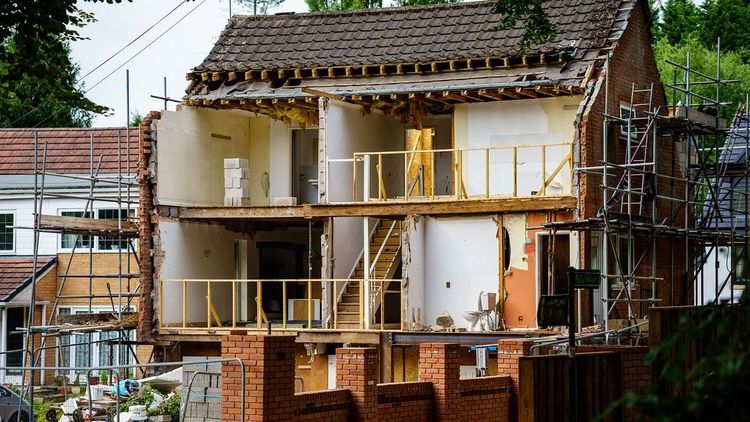
Property expert's critical advice for homeowners after builder collapse: Document everything now
Property inspector Zeher Khalil has issued urgent guidance to homeowners caught in the Bathla Group collapse, warning that immediate documentation could make the difference between a successful insurance claim and financial disaster.
Bathla was placed into voluntary administration on Tuesday, leaving up to 25,000 unfinished homes in limbo and at least 500 jobs at risk. The group reportedly owes an estimated $3.6 billion to private credit firms and other creditors.
"Document everything before anyone touches the site. Photograph the home as it stands, keep every document, and get an independent report on the stage of completion and any defects. If it ends up as an insurance claim, that evidence is what the whole claim turns on."
Mr Khalil, known as the 'TikTok Inspector', uses his decade of construction experience to educate potential buyers online about avoiding poorly built homes. He emphasized that affected homeowners need to act immediately to protect their interests.
Understanding voluntary administration
Under Part 5.3A of the Corporations Act 2001, voluntary administration gives companies protection from creditors while administrators assess whether the business can be saved or should proceed to liquidation. Teneo, a global advisory firm specializing in corporate restructuring and insolvency administration, has been appointed to handle the complex Bathla case.
"This is an extremely complex administration process. Our priority is to secure funding to ensure that the interests of employees, customers, and suppliers are protected to the greatest extent possible."
Teneo administrator Stephen Longley said.
Part of broader industry crisis
Bathla's collapse reflects a wider crisis in Australian construction. Over 2,600 construction companies entered external administration in the 2023-24 financial year alone, according to industry data. The sector has been hammered by supply chain disruptions, labour shortages, and construction costs that increased by an estimated 20-30% during 2022-2024.
Private credit firms have become increasingly prominent lenders to property developers as traditional bank lending tightened, though these loans typically carry higher interest rates and stricter terms. Bathla's $3.6 billion debt burden to such lenders illustrates the financial pressures facing developers.
The timing is particularly problematic given Sydney's ongoing housing affordability crisis, with median house prices exceeding $1 million and rental vacancy rates below 2%. Bathla's focus on affordable housing made it a critical supplier in a market with severe shortages.
Protection for NSW homeowners
For affected homeowners in New South Wales, there is some protection available. The Home Building Compensation Fund provides coverage for residential building work valued over $20,000 when builders become insolvent, covering up to $340,000 for incomplete work and defects.
However, Mr Khalil stressed that homeowners must ensure they have proper documentation to make successful claims.
"Check the builder's licence before you sign, not after. Don't hand over a cent until you're holding the certificate of insurance - that certificate is what stands between you and losing everything if the builder becomes insolvent."
He noted that in NSW, builders must have Home Building Compensation cover for residential work over $20,000, and they must have it before taking any money, including deposits.
Choosing quality inspectors
Mr Khalil also advised buyers working with other developers to obtain independent inspections at every construction stage - slab, frame, lock-up and handover.
"Be as careful choosing the inspector as you are choosing the builder. In NSW and Victoria, building inspection is completely unregulated; Queensland is the only state that licenses them. A cheap inspection that misses the problem is the most expensive document you will ever buy."
While Mr Khalil has not inspected any Bathla properties, he said he was unsurprised by reports of building defects and workmanship issues from some Bathla buyers in recent years.
"The type of complaints being reported is exactly that pattern which we see across the industry. Supervision is usually the thing that suffers when finances are stretched. Trades don't get paid, so they don't come back and homes get pushed through to handover with work incomplete or rushed."
Government policy pressures
Bathla managing director Bhart Bhushan cited a "perfect storm" of softening sales, changes to tax policies, and higher construction costs as factors in the collapse. Changes to capital gains tax and negative gearing policies affecting property investors were implemented in recent Australian Federal Budgets under the Albanese government.
A long-time friend of Mr Bhushan told the Daily Mail the managing director had been under immense pressure.
"I think the government has pushed people off a cliff. It takes a lot of risk to get to the position their business did. It's a sad story."
The friend said, referring to the tax changes.
Critical advice for affected homeowners
Mr Khalil's key recommendations for Bathla homeowners include securing the building site immediately and photographing everything in its current state. Homeowners should also check the Personal Property Securities Register - an Australian national online register where security interests in personal property can be searched - before removing any materials from their sites.
"Just because materials are on your site does not mean that you own them. If materials are subject to a registered interest, you will need to negotiate with the secured party."
Affected homeowners can contact Building Commission NSW on 13 27 00 or email Bathla's voluntary administrators at Bathla.customers@teneo.com with concerns.
The company's website states its broader development pipeline includes 22,000 apartment dwellings and a further 3,500 homes, worth $15 billion in total affordable housing projects. Administrators estimate up to 15,000 homes could be directly affected by the administration process.
As discussions continue between administrators and lenders to stabilize the company, thousands of Australian families remain in limbo, uncertain whether their dream homes will ever be completed.