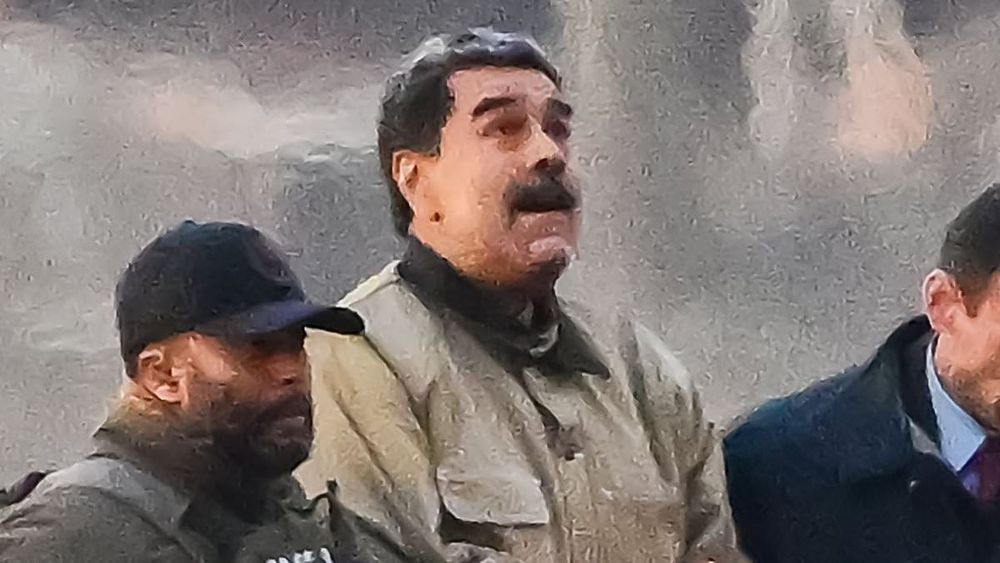
Maduro and Wife Appear in Court as Defense Signals Immunity Fight in Drug Trafficking Case
Nicolas Maduro, the ousted Venezuelan leader, appeared relaxed and confident during a 15-minute court hearing in Manhattan on Wednesday, smiling and waving to observers as a federal judge set a trial date of June 1, 2027, for drug trafficking charges against him and his wife, Cilia Flores.
The 63-year-old former strongman and his 69-year-old wife are each charged with conspiracy to traffic drugs through Venezuela to the United States. Both have pleaded not guilty and face life imprisonment if convicted.
Maduro and Flores were captured on January 3, 2026, in a dramatic U.S. military operation in Caracas ordered by President Donald Trump. The FBI's Hostage Rescue Team participated in the assault, and the couple were first transported to Guantanamo Bay before being flown to New York. During the operation, Flores sustained injuries including fractured or severely bruised ribs, according to court filings from her attorney.
Defense Strategy Centers on Immunity Claims
During Wednesday's hearing at the federal court in Manhattan, Maduro's defense attorney Barry Pollack signaled that the defense would seek to dismiss the case on grounds that the ousted leader should be immune from prosecution as the head of a sovereign state. In a letter filed ahead of the hearing, prosecutors acknowledged they expected both defendants to file motions claiming immunity.
Pollack, a partner at Harris St. Laurent & Wechsler LLP and former president of the National Association of Criminal Defense Lawyers, has extensive experience with high-profile international cases. He previously represented WikiLeaks founder Julian Assange for more than a decade, negotiating a 2024 plea deal that led to Assange's release from prison after he pleaded guilty to one count of violating the Espionage Act for publishing classified military and diplomatic documents. Pollack also won a complete acquittal for Michael Krautz, a former Enron accountant, in one of the few successful defenses stemming from the Enron prosecutions.
The immunity argument is complicated by the 1922 extradition treaty between the United States and Venezuela, signed in Caracas on January 19, 1922, and entered into force on April 14, 1923. The treaty contains a limited list of extraditable offenses, and narcotics trafficking is not explicitly listed among them. According to reports, Maduro's legal team could argue that an independent court of arbitration, rather than a U.S. federal court, should oversee the matter under the terms of this nearly century-old treaty.
Courtroom Demeanor and Prison Conditions
Sporting beige prison garb and a tightly-shaved haircut that made his face appear thinner than in previous public appearances, Maduro was escorted into the packed courtroom without shackles or handcuffs. He was observed joking with his lawyer that he looked "muy serio"—very serious—as proceedings began. Both defendants wore headphones to listen to a translator and took notes during the hearing.
Since their January arrest, Maduro and Flores have been detained at the Metropolitan Detention Center in Brooklyn, a facility that houses more than 1,300 inmates and has been widely criticized for its conditions. The facility's Special Housing Unit keeps inmates in solitary confinement under highly restrictive protocols, with prisoners spending up to 23 hours per day locked in their cells. Attorneys and former inmates have described conditions at the MDC as "disgusting" and "horrifying." Notable past detainees include Ghislaine Maxwell, R Kelly, and cryptocurrency fraudster Sam Bankman-Fried.
Political Implications and Venezuela's Transition
The case carries significant political implications for both the United States and Venezuela. Delcy Rodriguez, who served as Venezuela's vice president from 2018 until January 2026, was sworn in as Venezuela's interim president on January 5, 2026, just two days after Maduro's capture. The 56-year-old Rodriguez is a longtime Maduro confidant, and her brother Jorge Rodriguez holds a senior position as president of the National Assembly.
Since Maduro's removal, the Trump administration has effectively been managing significant aspects of Venezuelan governance, with Secretary of State Marco Rubio reportedly controlling the country's finances and natural resource distribution. Rodriguez has called for Maduro's release and continues to assert that he remains Venezuela's legitimate president—a position that could bolster the immunity defense.
Speaking before departing for the Philippines for an Association of Southeast Asian Nations summit on Monday, Rubio indicated that a transition process away from the Maduro regime had begun, with opposition leaders meeting with Maduro's officials. Formal transition talks are scheduled to begin in August, though it remains unclear when or if elections will be held.
Charges and Allegations
According to the indictment, Maduro and Flores orchestrated what prosecutors describe as a "relentless campaign of cocaine trafficking" to the United States. The couple are also accused of involvement in kidnappings and murders of individuals who stood in their way, including a drug boss in Caracas.
During previous court appearances, Maduro has described himself as a "prisoner of war" and claimed he was "kidnapped" from his home country. His assertion that he remains the legitimate President of Venezuela forms a key part of his immunity argument, as international law generally recognizes that heads of state are immune from prosecution in foreign courts—a principle that has been upheld by the U.S. Department of State.
Under the approved trial schedule, defense lawyers will begin filing motions in early September to challenge the indictment. The U.S. Treasury Department's Office of Foreign Assets Control initially declined to issue a waiver allowing the Venezuelan government to pay Pollack's legal fees due to sanctions against Caracas, but reversed that decision after a court hearing in March, enabling Pollack to continue representing Maduro through trial.