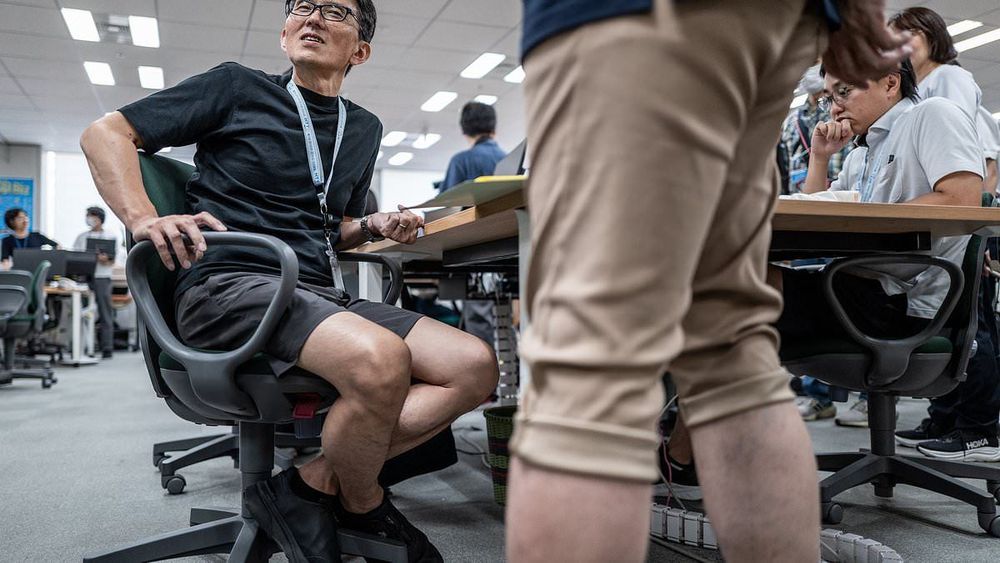
Women complain of 'leg hair harassment' after men told to wear shorts
Female office workers in Tokyo have voiced complaints about 'leg hair harassment' as men increasingly wear shorts to the office during a severe heatwave that has prompted authorities to issue extreme heat warnings.
Employees across the Japanese capital have been encouraged to abandon traditional suits and ties in favour of casual clothing including T-shirts and trainers as temperatures are forecast to reach 40°C in areas north of Tokyo. However, the relaxed dress code has exposed a gender disparity in workplace expectations, with women still required to wear tights according to traditional Japanese workplace etiquette.
The controversy centres on what some female workers have termed 'sunehara' – leg hair harassment – with women expressing discomfort at seeing their male colleagues' bare calves in the office. The issue has emerged as part of Tokyo Governor Yuriko Koike's 'Cool Biz' initiative, introduced in April, which aims to help workers cope with the extreme summer temperatures.
Divided opinion on workplace shorts
A survey conducted last month by Gorilla Clinic found that 53.5 per cent of workers opposed wearing shorts in summer, whilst 46.5 per cent supported the recommendation. The research identified body shape and body hair as the primary concerns for both men and women, though significantly more women responded to the survey, suggesting they feel more strongly about the issue.
The Cool Biz campaign, originally launched in 2005 by the Ministry of the Environment under then-Prime Minister Junichiro Koizumi, was initially proposed by Yuriko Koike during her tenure as Environment Minister. In its first year, the initiative resulted in an estimated 460,000-ton reduction in CO2 emissions, equivalent to the power used by approximately one million households over a month. The programme was extended from its original June-September period to run from May to October starting in 2011, following electricity shortages after the Tōhoku earthquake and tsunami.
Public health crisis drives policy
The push for relaxed dress codes comes against a backdrop of escalating heat-related casualties. Japan recorded a record high of 2,160 heatstroke deaths in 2024, with annual deaths exceeding 1,500 on average in the five years to 2024. Workplace heatstroke casualties reached a record 1,803 in 2025, up 546 from the previous year, according to the Health, Labor and Welfare Ministry.
Last year, Japan recorded an all-time national temperature high of 41.8°C, with more than 100,000 people taken to hospital for heatstroke during that summer. The weather agency has now introduced the term 'kokushobi' – meaning 'brutally hot day' – as an official classification for days when temperatures reach 40°C or above, reflecting the increasing frequency of such extreme conditions.
Japan's weather agency has forecast two days of kokushobi conditions, with temperatures expected to reach 40°C in Kumagaya, north of Tokyo. Authorities have urged residents to use air conditioning liberally, hydrate regularly and avoid prolonged outdoor exposure.
Gender inequality in dress codes
The current debate reflects broader tensions over gendered workplace expectations in Japan. Japanese workplace etiquette traditionally advises women to wear natural-coloured stockings that closely match skin tone as part of professional attire, rules that persist even during extreme heat.
The issue echoes the #KuToo movement, which began in 2019 as a campaign against workplace requirements for women to wear high heels. The movement's name combines 'kutsu' (shoes), 'kutsuu' (pain), and references the #MeToo movement. In 2019, Health Minister Takumi Nemoto responded to a petition from the movement by stating that workplace requirements for women to wear high heels were 'necessary and appropriate' in certain workplaces, highlighting institutional resistance to changing women's workplace attire expectations.
Noboru Watanabe, environment spokesman for the Tokyo Metropolitan government, said the policy aims to provide options rather than dictate clothing choices.
We want to give people more options in the severe heat, not tell them what to wear. There should be no issue as long as the work attire is not offensive to anyone.
In recent years, more Japanese workers – particularly those in startups and technology companies – have begun wearing casual clothes to the office. The government's recommendation this year has made such attire more socially acceptable across a wider range of workplaces, though the persistence of gendered expectations continues to generate controversy.