Bull elk attacks man at Great Smoky Mountains National Park during mating season
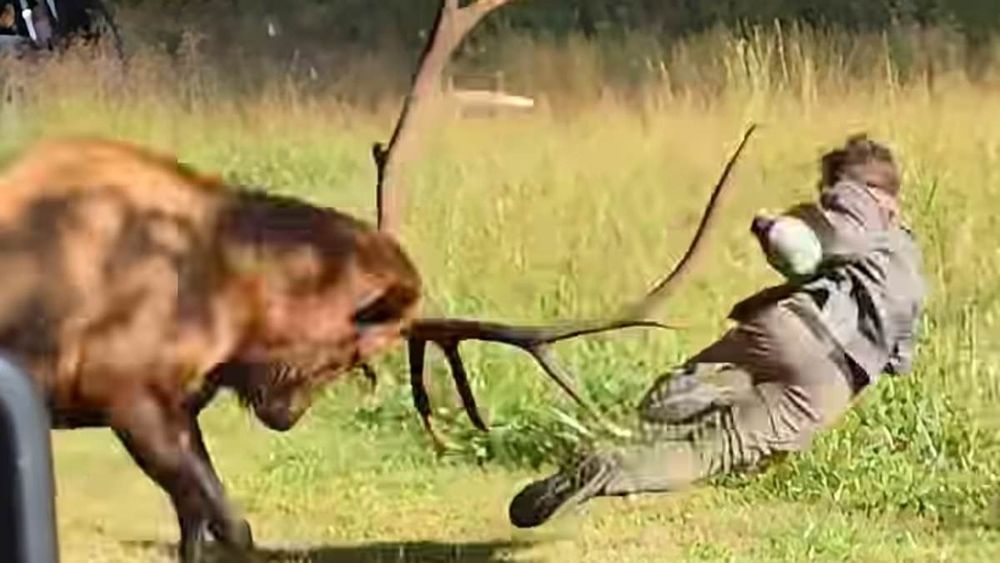
A bull elk violently attacked a man at Great Smoky Mountains National Park on Saturday, charging and headbutting him with enough force to send him flying through the air as horrified witnesses honked their horns to drive the animal away.
The incident occurred at the Oconaluftee Visitor Center, located at the southern entrance to the park near Cherokee, North Carolina, where elk are commonly spotted in the surrounding fields. Video captured by Tracy Howells shows the unidentified man attempting to hide behind a tree as the massive animal approached, then chasing him around the trunk before the man slipped and fell.
The elk, weighing up to 800 pounds and standing five feet tall at the shoulder, pounced on the fallen man and struck him with its antlers. Multiple bystanders immediately began honking their vehicle horns, successfully scaring the elk away. The man was left lying in the grass, though the extent of his injuries has not been disclosed.
Attack occurred during dangerous rutting season
The attack came just two days after park officials issued warnings about the elk rut, the mating season that runs from early September through late October. During this period, bull elk experience sharply elevated testosterone levels as they compete for dominance and mating opportunities, making them particularly aggressive and unpredictable.
Charles Sellars, Superintendent of Great Smoky Mountains National Park, released a statement urging visitors to maintain at least 25 yards distance from elk. Federal regulations actually require visitors to stay at least 50 yards from the animals at all times, and willfully approaching wildlife within this distance violates federal law.
Elk conservation success story
The elk population in the park represents a remarkable conservation success story. The animals were hunted to extinction in the region by the mid-1800s but were reintroduced between 2001 and 2002. The park brought in 25 elk from Kentucky's Land Between the Lakes in 2001, followed by 27 more from Elk Island National Park in Alberta, Canada in 2002. Today, the population has grown to approximately 200-240 animals, making them the largest mammals in the park.
Sellars emphasized that elk are wild animals that react instinctually to perceived threats. He noted that females with calves and bulls are particularly likely to defend their territory during certain periods.
No plans to euthanize the elk
The viral video sparked concerns among some viewers that the elk might be euthanized, prompting a petition that gathered nearly 5,000 signatures. The petition argued that punishing a wild animal for acting on its instincts when a human violated safety guidelines was unjust.
However, Sellars quickly dispelled those concerns, confirming in his statement that the park has no plans to euthanize the elk involved in the incident.
Safety guidance for visitors
Park officials have issued specific safety guidance for the rut season, advising visitors never to stop in the roadway or pull over to watch elk, and never to feed the animals. The warnings come as Great Smoky Mountains welcomes over 14 million visitors annually, making it the most visited national park in the United States.
During the rut, bull elk use distinctive vocalizations called bugles—high-pitched calls that can be heard over a mile away—to attract females and warn rival males. The animals shed their antlers at the start of each year and grow new ones under a velvet covering by August. As the rut approaches, hormonal changes cause the velvet to be rubbed off, revealing sharp new antlers used for intimidation and sparring.
Howells, who shared the video on social media, urged others to keep their distance from the elk, especially during the rutting season. Her post quickly gained traction online, with many commenters warning about the dangers of approaching wild animals.
One commenter emphasized that such incidents can occur anywhere wild animals are present, not just in well-known parks like Yellowstone. Others who regularly visit the area to view elk stressed that it is not a petting zoo and that posted warning signs should be taken seriously.