The start of a long association
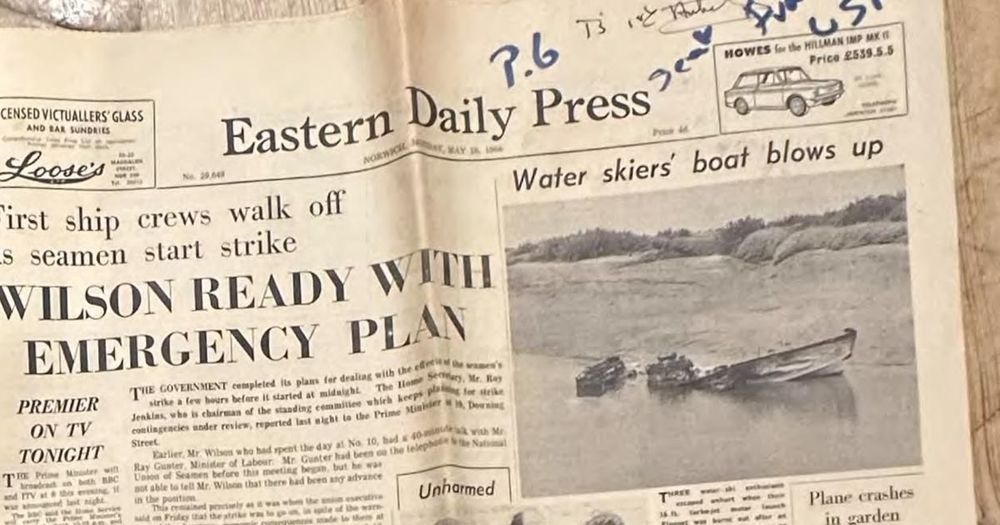
Barr believes his parents kept the newspaper because it contained his first published article. He was living in the United States when he wrote the nostalgic piece about Britain, beginning an intermittent association with the EDP that has lasted 60 years.
His later contributions ranged from accounts of buying a cottage to articles about drowning, backaches and sugar beets. He also spent a long period writing the regular "You and Your Law" features.
After years without a byline in the paper, Barr has returned as a letter writer. In the past six months, he says, the EDP has published more of his letters than it did during the preceding 60 years.
A strike and a rescue on the front page
The government's response to the seamen's strike led the news in the saved edition. Its plans had been finalized, and Prime Minister Harold Wilson was scheduled to address the nation that evening on both BBC and ITV.
The dispute involved the National Union of Seamen and extended nationwide. A week after the edition appeared, on May 23, 1966, the Queen declared a state of emergency under the Emergency Powers Act 1920. Regulations effective May 24 gave the government powers covering ports, dock labor, road transport and food prices, according to Hansard's record of the May 26 Commons debate.
Another front-page story described how a Radio Caroline disc jockey helped save two girls whose catamaran overturned within 50 yards of the station's ship. Founded in 1964 by Ronan O'Rahilly and Allan Crawford, the offshore "pirate" station transmitted pop music from vessels outside British territorial waters. Wikipedia records that its MV Mi Amigo had run aground during a storm at Frinton-on-Sea on January 20, 1966. The station was subsequently targeted by the Marine, &c., Broadcasting (Offences) Act 1967.
Election coverage reported Conservative claims of 400 net gains in local voting, alongside net losses of 287 for Labour and 54 for the Liberals. Closer to home, resignations had left North Walsham Urban District Council with two seats to fill.
Health warnings and a sparse court column
What particularly caught Barr's attention was what he did not find: court reports involving violence, drug dealing or indecency. The edition's sole criminal case concerned a fisherman accused of stealing a clock, watch, pipe and clothing, valued at 35 pounds and five shillings, or £35.25 in decimal currency. The fisherman was remanded in custody.
Barr found the approach to public safety less reassuring. The paper reported that mercury-containing diaper-rash ointment prepared by some pharmacists had made babies ill with "pink disease." Rather than a ban, the response was a Pharmaceutical Society caution against its use.
The illness, also called infantile acrodynia, had been linked to mercury in 1948 by a Cincinnati pediatrician. Calomel, or mercurous chloride, used in teething powders and similar remedies was the chief source. The Western Journal of Medicine cites official figures showing 585 deaths from pink disease among children in England and Wales between 1939 and 1948. Even in 1950, the illness represented more than 3% of admissions to London hospitals' children's wards.
Barr also questioned the tone of the pesticide coverage. The Association of Public Analysts' secretary said that assessing crop-protection chemicals required much more information about how much pesticide residue people might consume. He singled out young people, who could accumulate residues or their breakdown products over many years, while describing the benefits of those chemicals as "undoubted" and much of the criticism of modern food production as "uninformed."
Barr's observation that the official had neither the internet nor social media to contend with was accompanied by a speculative aside: perhaps nobody argued with him.
Cars, engines and the old currency
The motoring advertisements offered a 1966 Singer Vogue equipped with overdrive for £900, or a Hillman Imp showing 4,000 miles for £515. A separate business report described a £50,000 agreement for Peterborough-based Perkins to supply a Norwegian boatbuilding firm with 4,236 diesel engines. The paper's figures put the price at £11.80 per engine, not £50,000 apiece.
Perkins had been established in Peterborough in 1932 by Frank Perkins and Charles Wallace Chapman to manufacture high-speed diesel engines. According to Wikipedia, its biggest customer, Massey Ferguson, bought the business in 1959; it has belonged to Caterpillar Inc. since 1998.
The edition still used pounds, shillings and pence, with 240 old pence making up a pound. But the move to decimal currency was already planned. As the BBC recounts, Chancellor of the Exchequer James Callaghan announced the change on March 1, 1966, roughly two months before this newspaper appeared. Decimal Day followed on February 15, 1971, replacing that system with 100 new pence to the pound.
Road closures offered another contrast for Barr. He found a Norfolk County Council notice announcing that Station Road in Coltishall would shut for six weeks. He compares that with the many closures advertised each week in today's EDP, describing travel around the county as a maze-like exercise.
Broadcast schedules and a teenager's judgments
The entertainment listings included BBC programs Blue Peter and Jackanory, with Coronation Street on ITV. Radio listeners could tune in to Music While You Work on the Light Programme or Listen With Mother on the Home Service at 1:45 p.m. Barr also notes the absence of any Sky television listing.
Elsewhere, novelist Norah Lofts addressed the annual dinner of the Norwich Club of the Federation of Business and Professional Women. She was reported as saying that a country was "just as forward and efficient as its women are," a view Barr thought most people would share. He was less persuaded by her explanation that women remained unmarried not because of flat feet or knock knees, but because two generations of potential husbands had died in the wars.
The headline "Who won what in the SS show" briefly unsettled him before he realized it concerned the South Suffolk show. Royal coverage, meanwhile, reported that Prince Charles, then 18, had caught an eight-pound coral trout on Australia's Great Barrier Reef. Barr explains his recollection of the age by noting that the King is a year younger than he is.
His own teenage article now gives him pause, too. It praised America for qualities he believes it now seems to lack, proposed Britain's pre-decimal currency as a potential secret weapon against aggressors and described some women in Wisbech as fat. Barr doubts the piece would be published today and asks readers to forgive its teenage author, writing 60 years ago.