
Earnings divide two tech heavyweights
Alphabet's after-hours decline took its shares to around $288 after a rare shortfall in both revenue and earnings, according to Yahoo Finance. The stock had gained 1.60% during the regular session to close at $321.89. Microsoft moved in the opposite direction: After ending nearly unchanged at $531.01, it climbed to about $550 in extended trading as the company reported accelerating quarterly cloud revenue.
The contrasting results put AI spending back in focus. Both companies carry substantial weight in the Nasdaq Composite, and their cloud and AI investment plans underpin expectations for chipmakers and data center suppliers. Alphabet's miss could renew concerns about returns on that spending, an issue that has periodically unsettled the sector this year.
A late recovery follows the Fed decision
The Nasdaq added 72.04 points to Tuesday's 26,477.81 close, according to CNBC and The Globe and Mail. Other major indexes also posted small gains: The S&P 500 finished at 7,743.98, up 0.28%, while the Dow Jones Industrial Average advanced 0.19% to 52,475.10.
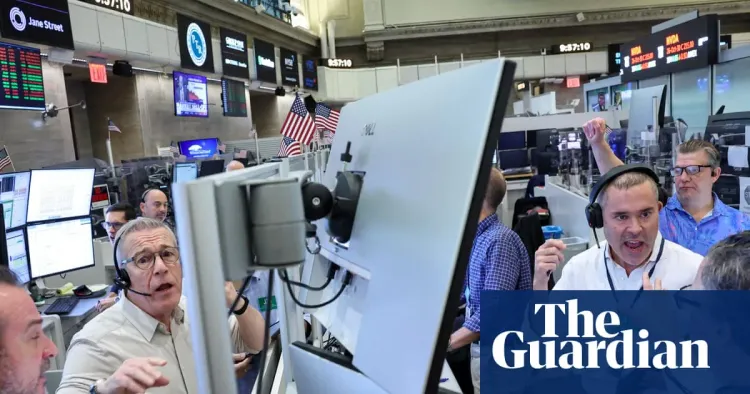
Trading was uneven. An opening gain of about 0.3% gave way to a late-morning loss of roughly 28 points, with the Nasdaq near 26,449. The index spent much of the afternoon close to unchanged before strengthening in the final hour after the Fed announcement. Wednesday's modest rise followed Tuesday's 1.18% advance, led by semiconductor stocks as the AI trade rebounded.
The Fed kept its policy rate in a range of 3.75% to 4.00%. The vote was 10-2, with Governor Lisa Cook and Cleveland Fed President Beth Hammack favoring an increase. Chair Kevin Warsh offered no guidance for December, while CME FedWatch data put the market-implied probability of a hike at that meeting at about 82.6%, up from earlier expectations.
Treasury markets delivered a mixed signal: The 10-year yield climbed to about 5.02%, but the 2-year yield declined, leaving a steeper yield curve. Higher long-term yields lower the present value of future earnings and typically pressure richly valued technology shares, helping explain the Nasdaq's limited advance despite some large individual gains.
Memory earnings and spending plans support chip stocks
Micron rose about 5.5% and SK hynix's U.S.-listed shares gained around 13% after the South Korean memory producer reported record quarterly revenue. The results reinforced demand for AI infrastructure, alongside strong orders at Vertiv, even as investors became more selective about which companies' spending they would reward.
SK hynix reported third-quarter revenue of 104.6155 trillion won and operating profit of 83.3338 trillion won, producing an 80% operating margin. Net profit reached 39.7756 trillion won, a 216% increase from a year earlier, with a net margin of 38%, according to SK hynix Newsroom.
In its October 28 outlook, the company said it expects memory demand to exceed supply through 2030. It forecast that sixth-generation HBM4 chips would overtake HBM3E in both shipment volume and revenue during the fourth quarter of 2026, becoming its mainstream product. Agreements with 14 major customers already cover more than half of its production capacity for 2027-2028.
SK hynix also announced approximately 100 trillion won in shareholder returns for fiscal 2026. The program includes at least 30 trillion won in cash dividends and at least 60 trillion won in share repurchases and cancellations; the latter includes 40 trillion won announced in August. Its board approved a third-quarter dividend of 20,000 won per share, including a special dividend of 10,000 won tied to gains from its Kioxia investment.
Genmab and Wendy's surge as other stocks retreat
Genmab's shares jumped about 30% following trial results showing a 50% reduction in the risk of death. The company said the Phase 3 LiGeR-HN1 study of petosemtamab plus pembrolizumab met both primary endpoints at its first interim analysis. The trial involved first-line treatment of PD-L1-positive recurrent or metastatic head and neck squamous cell carcinoma.
The overall-survival hazard ratio was 0.50, with a 95% confidence interval of 0.37-0.67 and p<0.0001. The objective response odds ratio was 3.17, with a 95% confidence interval of 2.06-4.89. Genmab reported that the endpoints were met regardless of HPV status and plans to discuss the findings with global regulators and present full results at a future medical meeting.
Wendy's gained about 14% after confirming a Trian-led proposal to buy the company for $7.35 per share in cash. Disclosed October 28, the offer values the chain at about $1.4 billion and represents a roughly 20% premium to Tuesday's closing price, according to CNBC. Trian, Wendy's largest shareholder with a 16.25% stake, is joined by Flynn Group, BlueFive Capital and Sixth Street Partners.
Wendy's established an independent committee after a February 18, 2026, Schedule 13D/A filing. The company is scheduled to release third-quarter earnings on November 5.
Among the decliners, weak solar demand and reduced fourth-quarter guidance sent Enphase Energy down about 17%. F5 lost roughly 20% after issuing slower-growth guidance. Logitech fell about 12% as a supplier plant outage hurt its holiday forecast, while Robinhood declined about 3.5% after reporting a 55% year-over-year drop in crypto revenue.
More stocks rise, but new lows dominate
Nasdaq advancers outnumbered decliners 2,849 to 1,926, a ratio of about 1.48 to 1, according to The Globe and Mail. Yet the exchange registered 198 new 52-week lows against just 75 new highs. The figures point to continued pressure on many smaller and interest-rate-sensitive companies despite the recovery in AI leaders.
The Composite remained about 3.8% below its October 6 record close of 27,599.89. Concerns over AI financing costs and rising bond yields drove the mid-October pullback. Wednesday's uneven participation also left the recovery less durable than a rally supported by a broader range of companies.
Asian markets lead global gains
The chip rally produced larger advances in Asia, where South Korea's Kospi jumped about 6.6% and Taiwan's Taiex added around 2%. Japan's Nikkei 225 ended at 63,954.19, a gain of 1.08%.
Moves elsewhere were smaller. Germany's DAX 40 rose 0.44%, France's CAC 40 finished flat, and Canada's TSX gained 0.26%, with technology and energy stocks leading the Canadian advance.
Thursday brings earnings and inflation tests
Alphabet's and Microsoft's earnings reactions will be a focus at Thursday's open. For the Nasdaq, the nearby support area includes Wednesday's late-morning low around 26,449 and Tuesday's close of 26,477.81. A move below that area, especially if Alphabet's extended-hours losses persist, would signal weakening momentum in the chip-led rebound. A recovery to 27,000 would bring the October record back into view.
The 10-year Treasury yield is another pressure point. It has traded near 5% this week, with moves above that level tending to weigh on high-growth stocks. A stronger-than-expected PCE inflation reading could bolster expectations for a December rate increase and lift long-term yields further, adding pressure to technology valuations.
Samsung Electronics is scheduled to report third-quarter results Thursday. U.S. third-quarter GDP and September PCE inflation data are due at 8:30 a.m. ET.