
Tech shares lead the advance
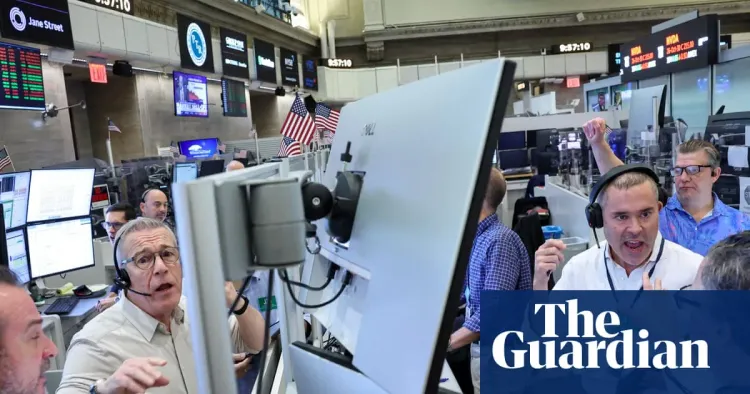
The Nasdaq Composite gained 0.82% to close at 26,169.38, while the S&P 500 added 0.70% to reach 7,676.77. The Dow Jones Industrial Average recovered part of its steep loss from the previous session, rising 146.42 points, or 0.28%, to 52,361.58.
Investors moved back into chipmakers and other AI-related stocks following Anthropic's filing. Synopsys climbed 8.67%, Intel gained 6.45%, Texas Instruments rose 5.94% and Micron Technology added 4.28%. Akamai Technologies topped the S&P 500's gainers with a 9.26% advance. Not all technology shares participated: Netflix lost 4.67%, Intuit fell 4.44% and Adobe declined 4.37%.
Anthropic discloses rapid growth and large losses
Anthropic, the developer of Claude, plans to trade on Nasdaq under the symbol ANT. Investors hope its IPO will revive momentum in a technology sector that has shown signs of fatigue.
The company's revenue reached $16.29 billion in the six months through June 30, up 1,304% from $1.16 billion a year earlier. Anthropic also said its annualized revenue run rate had increased from roughly $1 billion in early 2025 to more than $47 billion in 2026.
Those gains came alongside widening losses. Stock Analysis reported a first-half 2026 net loss of $80.7 billion, compared with $12.9 billion in the corresponding 2025 period. For all of 2025, Anthropic recorded $4.59 billion in revenue and a net loss of approximately $41.9 billion.
According to Stock Analysis, the S-1 registration statement submitted to the SEC on October 26, 2026, names Goldman Sachs as the first-listed underwriter, followed by Morgan Stanley. The two banks also underwrote SpaceX's June 2026 IPO.
The filing follows a $65 billion funding round completed in May at a $965 billion valuation. Altimeter Capital, Dragoneer, Greenoaks and Sequoia Capital led that round, Stock Analysis reported. Several weeks afterward, Microsoft disclosed a $3.2 billion gain on its Anthropic stake, stemming from a $5 billion investment in November 2025.
Meta seeks funding for AI infrastructure
Meta Platforms launched one of the largest stock offerings ever attempted by a US technology company, seeking $95 billion to help finance its AI infrastructure spending. It will raise $35 billion through underwritten new shares and another $60 billion through an at-the-market program.
Meta described "significant opportunities" for AI in both its existing businesses and new products. CNBC reported that Nvidia, Advanced Micro Devices and Broadcom had expressed interest in buying a combined total of up to $5 billion of the shares. Those indications are non-binding.
The company now projects 2026 capital expenditures of $135 billion to $145 billion, lifting the lower end of its forecast from $130 billion. According to CNBC, Meta is building four facilities it calls "superclusters," each exceeding 1 gigawatt of capacity. It remains on track to nearly double its total infrastructure capacity from 2025 to 2026.
Verizon falls despite higher earnings
Verizon was the Dow's biggest decliner, dropping 3.49% to $43.10 despite reporting higher third-quarter revenue and profit. Operating revenue totaled $34.3 billion, a 1.5% increase from a year earlier, while consolidated net income grew 5.2% to $5.3 billion.
Earnings per share reached $1.25, compared with $1.17 a year earlier. On an adjusted basis, EPS rose 8.3% to $1.31 and EBITDA increased 8% to a record $13.8 billion.
The carrier added 406,000 postpaid phone customers on a net basis in the third quarter. Verizon said that represented growth of more than 820% from a year earlier and its best third-quarter result in five years. It raised its full-year 2026 forecast for postpaid phone net additions to between 1.1 million and 1.2 million, from 750,000 to 1 million.
Verizon also announced an agreement exceeding $2 billion with Amazon Web Services. The company said the deal provides a commercial framework for expanding distributed computing to serve agentic and generative AI workloads. Data Centre Dynamics reported that it follows a roughly $1 billion agreement signed earlier in 2026 to supply dark fiber connecting Google's data centers.
CEO Dan Schulman said Verizon had signed approximately $4 billion in fiber and edge-computing contracts. Its first long-term contracts are expected to bring in hundreds of millions of dollars over their duration. Under a separate multiyear supply agreement, Corning will provide Verizon with more than 80 million miles of high-density optical fiber through 2032.
Rate decisions approach as US activity edges higher
The Federal Reserve announces its rate decision Wednesday, followed by the European Central Bank on Thursday and the Bank of Japan on Friday. Futures pricing indicated roughly a 90% probability that the Fed would leave rates in the 3.75% to 4% range. Bank of America nevertheless said a quarter-point increase was possible, though it would be a "heavy lift."
US economic data showed a modest improvement in September. The Chicago Fed's national activity index moved from -0.08 in August to +0.07. Its three-month average increased to +0.03 from +0.01, indicating activity slightly above trend.
Production provided the largest positive contribution, moving to +0.13 from -0.06. The contribution from sales, orders and inventories also turned positive, at +0.02 compared with -0.03 in August. Employment had a broadly neutral effect after a small drag the previous month. Personal consumption and housing moved in the opposite direction, with their combined contribution falling to -0.08 from +0.02.
Oil retreats after last week's surge
Brent crude slipped 0.78% Monday to $115.81 a barrel, while West Texas Intermediate lost 0.35% to $101.40 a barrel. The decline followed a sharp rise last week: Brent reached its highest price since April on Friday amid reports that the US and Israel might be preparing strikes on Iran after the US midterm elections.
NDTV Profit reported that Brent had risen about 90% in 2026 as the Iran war disrupted energy supplies and expanded to include Yemen's Houthi rebels. Crude shipments through the Strait of Hormuz have nevertheless returned to near prewar levels despite Iranian attacks on vessels. Markets are watching Tuesday's Israeli elections and the US midterm elections in early November.