
The political test behind the research
In a working paper discussed on CEPR's VoxEU, Nikiforova examines a question that divided German politics before the February 2025 election: can a mainstream party attract a radical-right rival's voters by adopting positions closer to theirs? Unlike much earlier research, the analysis lets the rival respond rather than treating the mainstream party's move as the end of the contest.
The question became especially contentious in January 2025, when CDU leader Friedrich Merz secured Bundestag support for a nonbinding motion demanding much tighter migration policy. AfD votes helped it pass, prompting accusations that Merz had breached the firewall against cooperation with the far right.
The CDU had formally ruled out coalitions and similar cooperation with both the AfD and the Left Party in its 2018 "incompatibility resolution." Former CDU Chancellor Angela Merkel publicly criticized Merz after the January vote for abandoning his pledge not to depend on far-right votes.
The motion did not lead to a new migration law. On January 31, 2025, lawmakers rejected the CDU/CSU's binding follow-up, the Influx Limitation Law, with 349 opposed, 338 in favor and five abstentions.
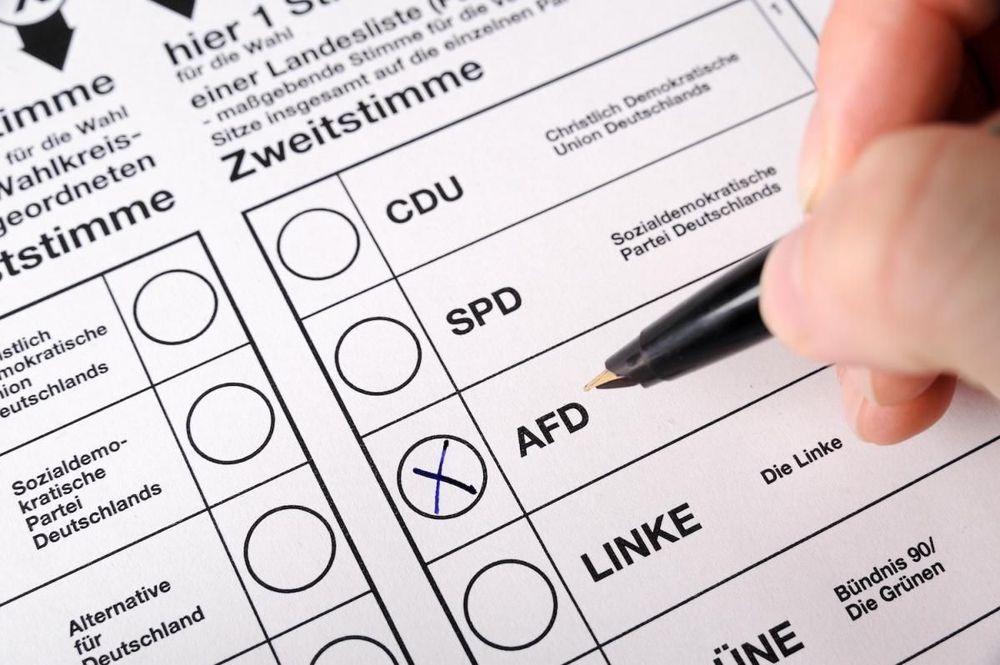
In the February 23 election, the CDU/CSU conservative bloc received 28.5% of second votes, with 22.6% for the CDU and 6.0% for the CSU. The AfD finished second at 20.8%, compared with 10.4% in 2021, while the SPD dropped to 16.4%. The Federal Returning Officer's provisional results put turnout at 82.5%, the highest since German reunification.
A rival's response reverses the result
The simulations first hold the AfD at its 2025 position while allowing the CDU to move right. A shift of 0.2 standardized units, equivalent to about 22% of the CDU's starting score on the left-right scale, attracts roughly one-fifth of AfD voters. Even after losing some voters on its left, the CDU adds about 3 percentage points to its vote share. The AfD loses more than 4 percentage points.
Within the range tested, larger rightward CDU moves produce larger CDU gains and AfD losses when the AfD cannot adjust. In policy terms, the paper suggests that a 0.2-unit shift could represent a tougher immigration stance approaching, but not fully adopting, the AfD's position.
The outcome changes when the AfD gets to choose its position after the CDU moves, while all other parties remain fixed. In response to a 0.2-unit CDU shift to the right, the AfD maximizes its vote share by moving farther right itself. That draws back some voters at the right-hand edge of the ideological scale who had switched to the CDU. The AfD still loses support, but less than it would without responding; both parties finish below their starting vote shares.
Under these conditions, the CDU's best option is not to move. The AfD's most favorable response is then a 0.1-unit shift to the left, attracting voters from other parties on that side. This also benefits the CDU: some far-right voters with relatively weak anti-elite views now find it the closer choice. In that scenario, both parties improve on their starting results.
How the simulations measure voter choices
The model separates two aspects of political preference: a voter's position on the left-right spectrum and hostility toward the political establishment and its institutions. It estimates both where voters stand and the weight they give each dimension.
To do that, Nikiforova uses differences among candidates running for the same party across Germany's 299 electoral districts. German voters cast one ballot for a local candidate and another for a party, with the party vote determining each party's share of Bundestag seats. Local candidates do not all follow their party's national position equally closely.
The analysis combines two candidate surveys with municipal-level voting results. Variation in candidate positions and party support provides the basis for estimating voter preferences. The model then recalculates voters' choices under alternative party positions. To reflect uncertainty in the estimated preferences, the reported results are medians across 100 draws.
On the standardized left-right measure, parties' median candidate positions range from -0.73 for the Left Party to 1.14 for the AfD; the CDU is at 0.90. On the anti-elite measure, the range runs from about -0.30 for the SPD and CDU to 0.68 for the AfD. The simulations change only the CDU's and AfD's left-right positions, using 0.1-unit steps and limiting moves to 0.2 units.
Why anti-elite attitudes change the calculation
The second dimension is central to the finding. If parties competed only along a single left-right line, a radical-right party would generally benefit from moving toward an approaching rival. It would already have the voters farther to its right, so moving away would sacrifice support in the middle. Once anti-elite attitudes also influence choices, a move farther right can instead help it recover voters.
Nikiforova finds that many AfD voters in 2025 combined radical-right positions with relatively weak anti-elite attitudes. Their support rested more on the party's right-wing policies than on its opposition to the establishment. That makes them potential CDU voters, but also gives the AfD a reason to move farther right if enough of them are at risk of leaving.
Infratest dimap estimates that the AfD's net gain from the CDU between 2021 and 2025 exceeded one million voters. Their earlier support for an establishment party suggests that some may not share the AfD's anti-elite outlook. The paper stresses that a different distribution of views across the two dimensions could produce different strategic choices.
Accommodation is not a guaranteed route to votes
The strategy of moving closer to a populist rival is known as accommodation. Previous research finds that mainstream parties often shift right after radical-right electoral successes, but whether doing so wins votes remains disputed.
Denmark is frequently cited as a case where restrictive immigration policies helped the Social Democrats weaken the Danish People's Party. The latter's vote share fell from its 2015 peak of 21.1% to 8.7% in 2019 and 2.6% in 2022. The Social Democrats, having adopted restrictive immigration positions, won reelection in 2022 with 27.5%, their strongest result since 2001.
In Germany, the AfD continued advancing after the 2025 election. By August 2026, the ARD-Deutschlandtrend poll conducted by infratest-dimap put it at a record 28%, ahead of Chancellor Merz's CDU/CSU, whose support had slipped slightly. The same survey found that 37% of voters rejected any cooperation with the AfD, 32% preferred case-by-case decisions and 27% generally supported cooperation.
Nikiforova's conclusion is conditional on the modeled competition: the CDU does better by holding its position than by making the substantial rightward shift tested when the AfD can answer. The author also warns that accommodation may encourage further radicalization and normalize positions previously associated with the far right, pulling political debate rightward without delivering electoral gains for the mainstream party.