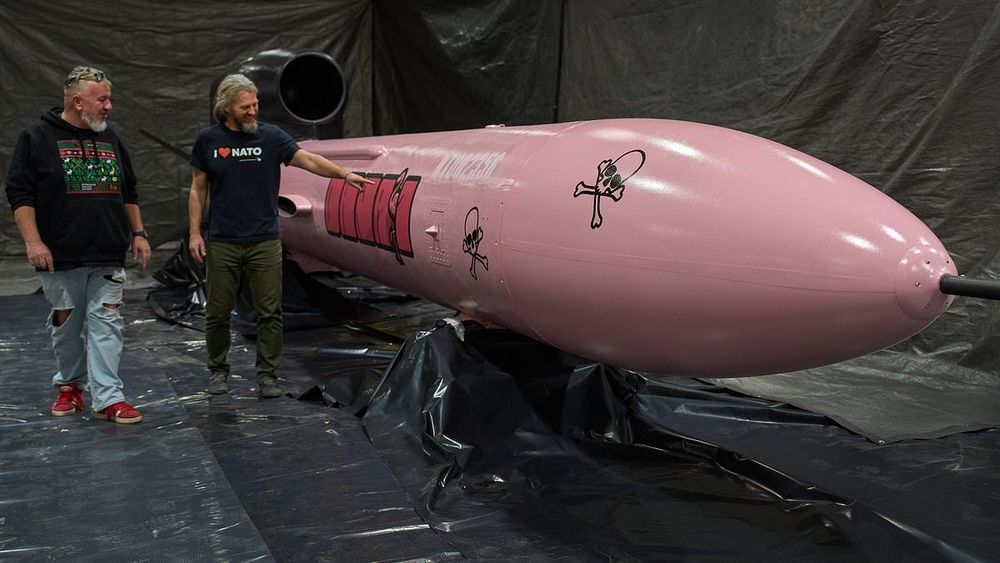
Ukraine's Flamingo Missile: The Pink Budget Weapon Reaching Deep Into Russia
A Ukrainian defense startup founded by engineers, architects, and game designers has developed a cruise missile that is challenging Russia's military dominance—using engines salvaged from landfill sites and costing just $500,000 per unit.
The FP-5 Flamingo, distinguished by its bright pink nose cone on early prototypes, represents a remarkable achievement in wartime innovation. At 45 feet long with a 20-foot wingspan, the six-tonne missile carries a one-tonne warhead and can strike targets up to 1,900 miles away at speeds reaching 600mph.
Fire Point, the manufacturer behind the Flamingo, was established in 2022 in direct response to the Russian invasion. The company rapidly evolved from makeshift workshops to multiple covert production facilities across Kyiv and surrounding regions, staffed by individuals with no traditional military-industrial background.
Ingenious Cost-Cutting Engineering
The missile's affordability stems from creative engineering solutions. Fire Point powers the Flamingo with the Ivchenko AI-25TL turbofan engine, originally designed in the late 1960s for the Czechoslovak Aero L-39 Albatros military trainer aircraft. Development of this engine was completed in October 1971, and approximately 5,000 to 6,000 units were manufactured over subsequent decades.
Many of these engines were scrapped at the end of their service life, allowing Ukraine to acquire them from landfill sites at minimal cost. Fire Point restores these surplus engines not to full aviation standards, but to specifications sufficient for the Flamingo's flight time of approximately three to four hours. The company has replaced expensive titanium components with cheaper alternatives while maintaining flight-worthiness, further reducing production costs.
By comparison, America's Tomahawk Block V cruise missile costs between $1.87 million and $2.5 million per unit, carries a 450-kilogram warhead, and has a range exceeding 1,600 kilometers—less than half the Flamingo's range and payload at nearly four times the price.
Closing the Strategic Gap
The Flamingo addresses a critical asymmetry in the conflict. Russia routinely bombards Ukraine with cruise missiles, ballistic missiles, hypersonic weapons, and experimental systems like the Oresnik. Until the Flamingo's deployment, Ukraine lacked comparable long-range precision strike capabilities under its own control.
Western-supplied weapons have faced limitations. Ukraine's ATACMS missiles have a maximum range of 300 kilometers and carry a 227-kilogram warhead, while Britain's Storm Shadow cruise missiles reach between 250 and 560 kilometers. Both systems were restricted from striking Russian territory until November 2024, when the United States and United Kingdom lifted these constraints.
The Flamingo's range of 1,900 miles places it in an entirely different category, putting approximately 90 percent of Russian defense industries within striking distance. Both Moscow and St. Petersburg now fall within its operational envelope, transforming the weapon from a tactical system into a strategic deterrent.
Combat Record and Production Scaling
Ukraine's first Flamingo strikes occurred in late August 2025, targeting an outpost in Crimea approximately 65 miles behind the front line. Three missiles were launched, two arrived on target, and one scored a direct hit—proving the system's viability.
Subsequent strikes have progressively tested the missile's range. In September 2025, four Flamingos hit a fighter jet component factory in Belgorod, Russia, about 40 miles from the front. By February 2026, strikes were reaching targets over 800 miles inside Russian territory, including the Votkinsk missile factory—far beyond the reach of any Western-supplied weapon Ukraine has received.
The most recent documented strike occurred in May 2026, when six missiles targeted the Cheboksari factory producing navigation components for Russian military vehicles. One missile landed a direct hit, though the full extent of damage remains unknown. Open-source analysis has confirmed a total of six verified Flamingo attacks through May 2026, with 23 launched missiles captured in available footage.
Fire Point claims current production stands at two to three Flamingos per day, with ambitions to reach seven daily. The company can produce over 50 missiles monthly and plans to scale to 200 per month. To support this expansion, Fire Point is establishing its own engine production plant in Ukraine and a missile fuel facility in Denmark near the Skydstrup air force base.
International Recognition and Future Development
The Flamingo program has attracted significant international attention. The United Arab Emirates is planning to acquire a stake in Fire Point, with the Ukrainian defense company valued at $2.5 billion as of June 2026.
Fire Point is also developing a broader weapons portfolio beyond the Flamingo. The company manufactures the FP-1 series of long-range strike drones capable of reaching 2,000 kilometers, which have already been deployed against Russian targets. Additionally, Fire Point is working on the FP-7 tactical ballistic missile and FP-9 ballistic missile systems, with the FP-7 expected to complete codification by Ukraine's Ministry of Defence by the end of 2025.
The Flamingo's emergence represents a fundamental shift in the conflict's dynamics. For the first time since the war began, Ukraine possesses a long-range precision strike weapon entirely under its own control. Russia can no longer launch missiles into Ukraine with impunity, as Kyiv has demonstrated both the capability and willingness to strike back deep into Russian territory.
As one defense analyst noted, the Flamingo has transformed Ukraine's strategic position. The combination of exceptional range, substantial payload, affordable production costs, and domestic control means Ukraine no longer operates at a decisive disadvantage in the domain of long-range strike warfare.