
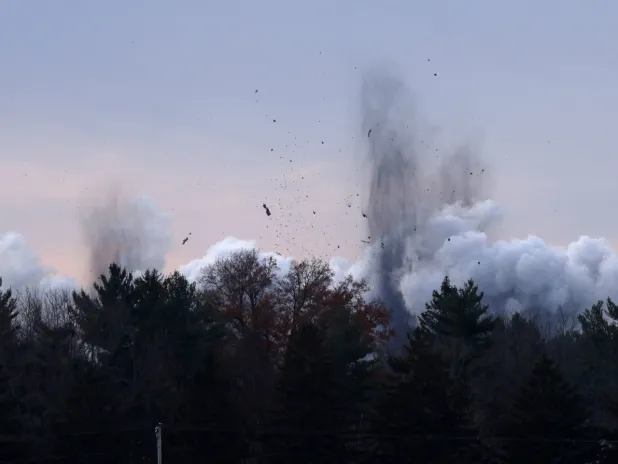
Monitoring continues as residents await clearance
The blast destroyed a stockpile held in 68 deteriorating plastic barrels at the Iowa Army Ammunition Plant in Middletown, about 150 miles southwest of Des Moines. Some nearby residents welcomed the removal of the explosives while questioning assurances about lead emissions, Reuters reported.
The Army and Environmental Protection Agency said monitors found no airborne lead in the surrounding region immediately after the explosion. The EPA reported the same result an hour later and said crews would continue collecting air, soil and water samples throughout the day. Those results would be compared with more than 1,200 samples taken the previous day.
Residents nearest the depot evacuated as a precaution. Rob Cekada, director of the Bureau of Alcohol, Tobacco, Firearms and Explosives, said about 21 people left their homes voluntarily and would receive return guidance from the Federal Emergency Management Agency. FEMA provided lodging for evacuees and told residents within 20 miles who had stayed home to continue sheltering in place until officials gave the all-clear.
Rhonda Woodson, a former plant employee living in nearby Burlington, said the detonation might have been "too hyped up," but she remained distrustful of federal information. About three hours after the explosion, her neighborhood still appeared deserted.
NASA supported environmental and atmospheric data collection with a P-3 Orion and a Gulfstream III from its Langley Research Center in Virginia, plus a contracted B200. The agency also used observations from its space-based Tropospheric Emissions: Monitoring of Pollution, or TEMPO, instrument.
Army says containment measures worked
Explosive ordnance disposal specialists from the Army's 71st Ordnance Group carried out the in-place detonation. The Army said it operated under an EPA-approved Resource Conservation and Recovery Act emergency treatment permit.
Acting Army Secretary Adam Telle called the "controlled, mitigated detonation" a "huge success" and said it had eliminated the danger of a spontaneous explosion. Army Col. Aaron Teller, the munitions specialist overseeing the operation, said all the lead azide barrels had been removed, with no secondary explosions and no infrastructure damage inside or around the installation.
Officials credited the site's containment system with limiting the release of lead particles. Crews had built earthen berms and two tall walls of water tanks designed to discharge into the blast zone. They also dampened nearby ground with mist and used fire trucks to cover the blast site with aqueous foam.
Cekada described additional safeguards: dirt-filled Hesco barriers reaching about 40 feet, water walls and water gels intended to trap particles. A heavy tarp covered the berm roof, topped by a mat designed to absorb lead particulates.
Why officials chose detonation
A March inspection uncovered dangerous crystallization in the barrels and their contents. Government experts said the material was becoming more unstable as colder weather arrived and would eventually explode without intervention. They concluded that moving the drums or attempting chemical neutralization would trigger an uncontrolled blast. The Army described detonation in place as the only viable way to eliminate the hazard permanently.
The stockpile contained about 4,500 kilograms of lead azide, a longtime detonating material in military ordnance that had been deemed largely obsolete years earlier. The Army consolidated unused supplies from bases across the country at the Iowa plant in 2009.
Disposal on this scale is rare. An Army explosives commander said the last major operation involving a comparable quantity took place in Colorado in 1977, when about 7,000 pounds were detonated without mitigation measures.
The Middletown facility also has a longer cleanup history. According to the Department of Energy, it helped build nuclear weapons between 1947 and 1975. The Army Corps of Engineers conducted cleanup work there as recently as 2021.
Fallout forecasts and cleanup commitments
Before the blast, concerns centered on lead dust reaching homes, crops and livestock. Army projections released Tuesday showed that particles could settle as far as 40 miles southwest, across southeastern Iowa and into northern Missouri. Airborne particles could travel nearly 100 miles in eight hours. Based on pre-detonation forecasts, U.S. and Iowa agriculture officials estimated that 350 farms might be affected.
The Army said the operation's RCRA-approved standards require government-funded remediation if a residential property tests above 200 parts per million, or mg/kg, of lead. Teams would remove contaminated soil, clean surfaces and restore the property at no cost to the owner. The U.S. Army Claims Service would also handle and pay claims for physical property damage caused by blast vibrations.