The charge and its cost
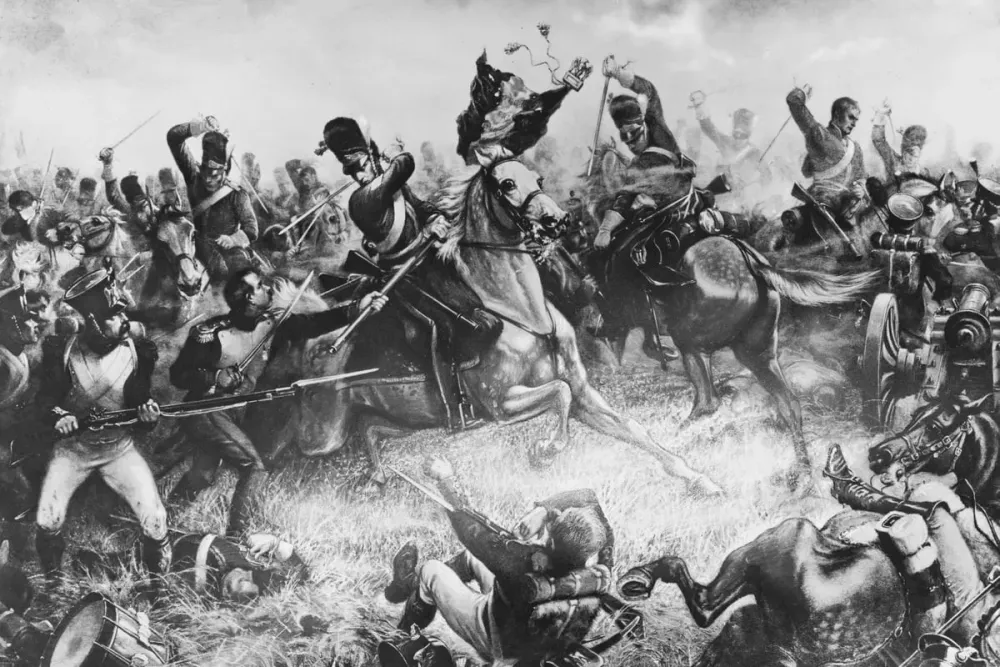
On June 18, 1815, the Royal Scots Greys began the Battle of Waterloo on Wellington's left flank. Shortly after 1:30 p.m., advancing French infantry threatened to break the British center. The order came for the Union Brigade and Household Brigade to attack.
The Union Brigade brought together the Royal Dragoons from England, the Royal Scots Greys from Scotland and the 6th Dragoons from Ireland. As the 92nd Highlanders faltered, the arrival of the Scottish heavy cavalry helped them rally and turn against the French. Mulholland credits the Greys with saving the day.
The regiment paid heavily: 104 men were killed, 97 were wounded, and 228 of its 416 horses were lost. Many of its troopers had entered the campaign without combat experience. According to the Napoleonic Archive, the Greys had been held back for most of the Peninsular War and had not served in Spain or Portugal before their deployment to Belgium in 1815.
The sergeant who took the eagle
Among the Greys at Waterloo was Sergeant Charles Ewart, an experienced soldier who stood 6 feet 4 inches tall and was skilled with both horse and sword. Undiscovered Scotland records his birth in 1769 at Biddles Farm near Kilmarnock, Ayrshire. He enlisted at 20, fought during the French Revolutionary Wars of 1792–1802 and, on one occasion, was briefly a French prisoner.
During the charge, Ewart seized the eagle of the French 45th Line Infantry Regiment. These standards drew on the eagles of the Roman legions, and Napoleon required his soldiers to defend them with their lives. The Greys' breakthrough disrupted French infantry forming a defensive line, and Ewart took the standard after close combat with several French soldiers.
The eagle had only recently reached the regiment. The Waterloo Association's Age of Revolution project identifies it as a replacement issued following Napoleon's return in 1815. The 45th received it on June 10, and its bearer during the Waterloo campaign was Porte-Aigle Pierre Guillot, a veteran of the Peninsular War.
The Union Brigade captured both French eagles taken at Waterloo. The Napoleonic Archive identifies the second captor as Captain Alexander Kennedy Clark of the 1st (Royal) Dragoons, who seized the standard of the French 105th Line Infantry Regiment.
Ewart's prize became a cherished regimental honor. An eagle appears on the Royal Scots Greys' cap badge, and the captured standard is displayed in the regimental museum at Edinburgh Castle. The exploit also earned the Greys the nickname "the Birdcatchers".
Public acclaim and an Edinburgh memorial
Celebrated after Waterloo, Ewart traveled around the country making speeches. In 1816, he received a commission in the 5th Veteran Battalion as an ensign, the lowest commissioned rank, equivalent to second lieutenant. That promotion supplied the name by which he is remembered: Ensign Ewart.
Public speaking did not always appeal to him. When Sir Walter Scott invited Ewart to address a Waterloo dinner in Leith in 1816, he asked to be excused, saying he would sooner fight the battle again than speak before such a large gathering.
His army service ended when the battalion was disbanded in 1821. Undiscovered Scotland says he later added to his pension by teaching swordsmanship. He spent his final years near Manchester and died at 77 on May 23, 1846.
Ewart was initially buried in a graveyard on Bolton Street in Salford. His grave was eventually paved over and forgotten, then rediscovered in the 1930s. In 1938, his remains were exhumed and the Royal Scots Greys reburied him beneath a large granite memorial on Edinburgh Castle Esplanade. The nearby Ensign Ewart pub, at the bottom of the esplanade, also preserves his name.
How the charge became an image of heroism
Elizabeth Butler depicted the opening of the charge in her 1881 oil painting "Scotland Forever!" Its title echoes the Greys' battle cry: "Now, my boys, Scotland forever!"
Reproductions carried the scene far beyond Britain. According to the Age of Revolution project, both Russia's Tsar Nicholas II and Germany's Kaiser Wilhelm II received copies. During World War I, from 1914 to 1918, Britain and Germany each used the image as propaganda; the German version recast the Scots Greys as Prussian cavalry.
The painting's prominent gray horses require a qualification. Wikipedia's entry on the work says the regiment appears to have ridden brown horses at Waterloo and earlier, as other heavy cavalry units did. The gray mounts Butler painted were allegedly used throughout the regiment's later history until mechanization. The name "Greys" derives instead from the gray uniforms worn by the regiment in the early 18th century.
Mulholland's case for remembrance
Having written in previous years about Scottish lawyers' service in the two world wars, Mulholland turns this Remembrance Sunday to conflicts he considers too often neglected. He describes the Napoleonic wars as a time when Britain faced invasion by a military genius commanding a powerful army and navy, and emphasizes the country's united resistance.
He traces Wellington's campaigns through the Peninsular War and into France and Belgium, ending at Waterloo. Mulholland also cites the assessment that the British Army had never been stronger than in 1814, when it ranked among Europe's most effective fighting forces, perhaps the best. His tribute extends to those who fought across Spain, Portugal, France and Belgium to stop Napoleon and prevent French domination of Europe.
He ends with an exchange he saw in graffiti on the plinth of Wellington's statue at Waterloo Place in Edinburgh during the 2014 referendum campaign. The description "English Imperialism" had been crossed out and replaced with "Surely you mean English, Scottish, Welsh and Irish solidarity against French imperialism". Mulholland recalls laughing at the response.