Closer sampling and newly identified workings
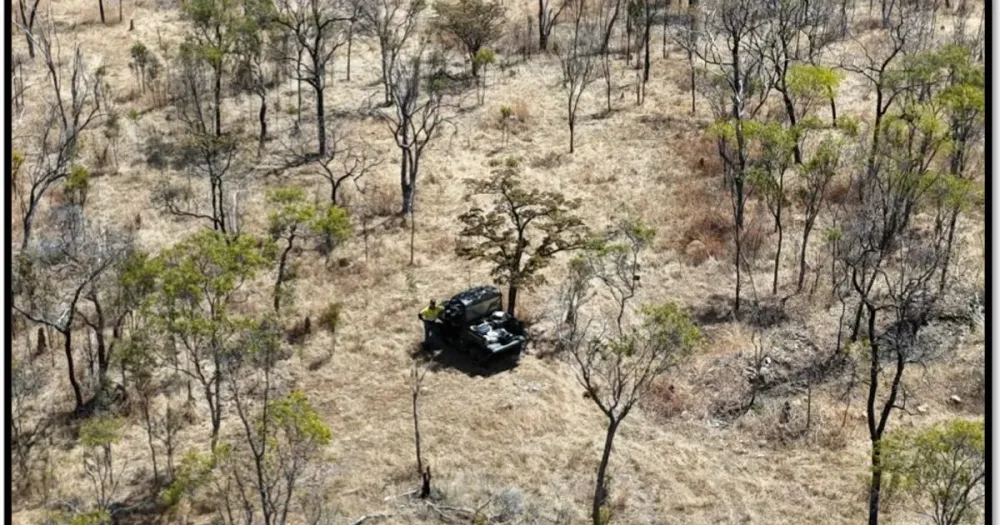
The latest field program followed earlier soil, rock-chip and drainage sampling. Lightning collected samples every 25 meters on infill and extension lines roughly 125 meters apart, seeking to define known tungsten anomalies more closely and trace their extensions. The anomalies remain open in several directions.
The exploration team also found additional historical workings and observed visible wolframite in hand specimens. Lightning plans to map these areas and collect surface rock-chip samples as it assesses further targets.
Managing director Troy Brice said the next priority was to combine the assays with LiDAR survey data and petrological work by the University of New South Wales (UNSW). He said this would help explain what controls the tungsten mineralization and allow the company to rank drill targets, directing exploration spending toward areas with the strongest technical support.
Earlier results and their limits
Lightning's September 2026 quarterly activities report, released October 30, reported tungsten grades above 1% W in five of six Phase 2 rock-chip samples, with the highest at 5.5% W. The company cautioned that the selective rock and dump samples neither represent bulk mineralization nor establish mineralized widths.
Combined Phase 1 and Phase 2 work outlined a tungsten-tin dispersion zone covering more than four square kilometers. Pan-concentrate results reached 4.5% W and 4.2% Sn, but Lightning emphasized that these enriched samples do not show in-situ grades.
The company said most of a prospective granite contact zone extending 13 kilometers remains untested. Tungsten soil anomalies are still open in multiple directions.
Regional setting and tungsten market
Warby is held under EPM 28262, northeast of Georgetown and near Lightning's Scardon tenement. The quarterly report places it about 25 kilometers north of Mount Surprise, in the same geological belt as the Mt Carbine tungsten mine. Regional processing infrastructure includes the operating Mt Carbine tungsten plant.
According to Industry Queensland, Lightning acquired Warby-Scardon through its purchase of Lotus Minerals. That transaction also added the Mt Turner gold project, about 15 kilometers northwest of Georgetown. Lightning has advanced Warby through geochemical sampling, mapping and geological interpretation as part of its critical-minerals strategy.
Lightning notes that several Western governments classify tungsten as a critical mineral and that China accounts for approximately 80% of processed global supply.
In a June 2026 interview with S&P Global Energy (Platts), EQ Resources managing director Craig Bradshaw put the global tungsten supply deficit at about 30,000 metric tons. He said prices outside China were holding at approximately US$2,800 to US$3,180 per metric ton unit.
EQ Resources approved an A$39 million (US$27.6 million) investment on June 3, 2026, to increase annual crushing capacity at its Queensland Mt Carbine operation from 1 million to 2 million metric tons. Bradshaw said the expansion was expected to begin operating by the end of the third quarter of financial year 2027.
Technical studies and drilling plans
Lightning plans to begin a LiDAR survey in November to map historical tungsten workings, look for other surface features and improve its interpretation of geological structures across Warby. It has also sent 13 samples to UNSW for petrological analysis of the mineral assemblages, host rocks and alteration associated with tungsten mineralization.
The company will combine those findings with soil geochemistry and field mapping to refine its geological model and assess how far the Warby vein system may extend. Work around the newly identified workings will include further mapping and rock-chip sampling, alongside interpretation of the Phase 3 assays and target ranking for possible trenching and maiden drilling.
In its September quarterly report, Lightning had forecast receipt of the Phase 3 assays in October 2026. It planned to interpret the results and generate drill targets during the December quarter, ahead of trenching and maiden drilling planned for 2027.
A maiden drilling campaign would test Warby's tungsten targets at depth for the first time. It remains subject to exploration results, approvals, access and the final program design.