Helicopter deal includes support and training
The Defense Ministry said the four Sikorsky helicopters would establish a new "tactical mobility capability" for the army. Argentine delegations negotiated in the United States to obtain a reduced price, according to the ministry.
Defense Minister Carlos Presti put the price of the aircraft, spare parts and consumables for the first 480 flight hours at about $28 million, Infodefensa reported. That compares with the $140 million estimate announced by the US State Department when it approved the possible Foreign Military Sale on September 10, 2026.
A separate initial Letter of Offer and Acceptance, signed on September 9, covers about $10 million in technical assistance, airframe selection and engineering studies. Including that agreement, the first batch is estimated to cost roughly $38 million, with payments tied to milestones through 2031.
US Ambassador Peter Lamelas described the agreement as a "concrete step in our defense cooperation" after its signing in the Malvinas Islands Hall in the capital. "These aircraft will enable Argentina to strengthen its border security, combat transnational crime, and assist its people in emergencies and disasters," he wrote on social media.
The ministry expects the first batch to reach Argentina before the end of 2026, according to Infodefensa. The planned route calls for a transport aircraft to carry the helicopters to Ezeiza, where they would undergo reception and preparation before flying to Campo de Mayo.
Army plans a fleet of up to 20
The first Black Hawks will be assigned to the army's 601st Assault Helicopter Battalion at Campo de Mayo. The program targets a fleet of up to 20 as the army gradually retires 25 Bell UH-1H Hueys. Further purchases are planned for 2027 and 2028, but depend on funding and new agreements, Infodefensa reported.
An initial group of six Argentine pilots and 12 mechanics is training in Colombia. The pilots' course combines simulator work at the Colombian Aerospace Force's Air Combat Command No. 4 in Melgar with flight training at Tolemaida. The mechanics train at the Colombian Army's Tolemaida military base.
Rocket campaign tests flight systems and sea recovery
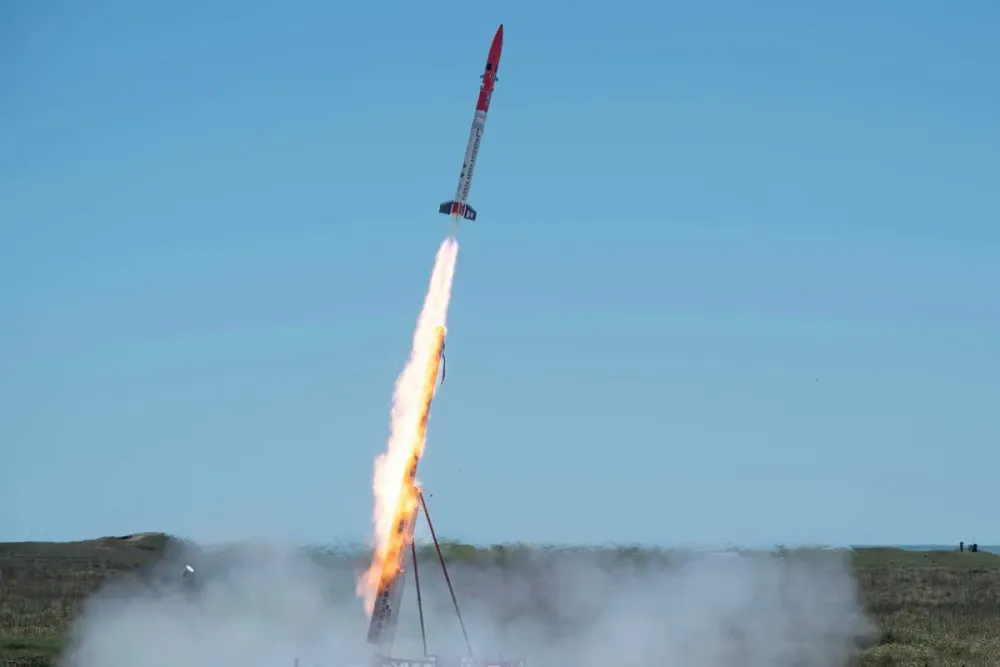
The air force conducted both rocket launches from the CELPA II Atlántico launch center at Mar Chiquita in Buenos Aires province. The MET 3-SO "Castor" launched at night on Tuesday, November 3, followed by the MET 4-SO "Pólux" on Thursday, November 5. The flights formed part of the "Géminis" campaign, according to the Defense Ministry.
Sounding rockets carry out measurements and technology tests during suborbital flights. Since tests last year, Argentina has continued developing domestically built engines and avionics, along with systems for recovery at sea. In a statement Friday, the ministry presented the work as an expansion of Argentina's aerospace capabilities under President Javier Milei.
For the latest flights, Castor carried a lighter engine and nozzle, while the Pólux test included an attempt to retrieve its payload from the sea. A new mission computer, still undergoing qualification, and new telemetry systems were also incorporated into the tests.
Recovery operations involved a light airplane, drones and vessels. Among the search equipment was the recently certified SAMIRP "BÚHO" drone, which used a new gimbal in coastal waters. Images released by the ministry appeared to show personnel returning salvaged rocket components to shore.
CITEDEF, Argentina's defense research institute, built the engines to engineering specifications set by the air force. The air force's Centro de Investigaciones Aplicadas developed the payload, recovery equipment, telemetry, fins, fuselage and avionics. Its Electronic Warfare Center worked with CITEDEF on a new flight-termination system.
US ties and the Falklands dispute
Closer defense cooperation and trade with the United States have supported Argentina's military expansion in recent years, although the country still devotes about 0.8% of GDP, or roughly $3.9 billion, to defense.
The modernization effort also includes 24 used, US-made F-16 fighter jets that Argentina agreed to buy from Denmark for $300 million in 2024. The first six arrived in December 2025. Milei called the purchase the country's most important military acquisition in 50 years, while the Defense Ministry said the aircraft would become the air force's backbone. Deliveries are expected in annual batches of six through 2028.
The buildup comes more than four decades after Argentina's 1982 defeat by Britain in the war over the disputed Falkland Islands. Milei's renewed sovereignty claims have heightened tensions in recent months, but in October he ruled out using military force to take the islands.
Speaking to The Telegraph, Milei repeatedly rejected military solutions and said: "We are going to get the Falklands back by diplomatic means. The Falklands are Argentinian, legally, historically and geographically."
Milei was emboldened by US President Donald Trump's suggestion that Washington could reconsider its neutral position on sovereignty over the islands. Trump also questioned Britain's ability to defend the territory, citing its domestic immigration and energy problems.