Explosions near the route
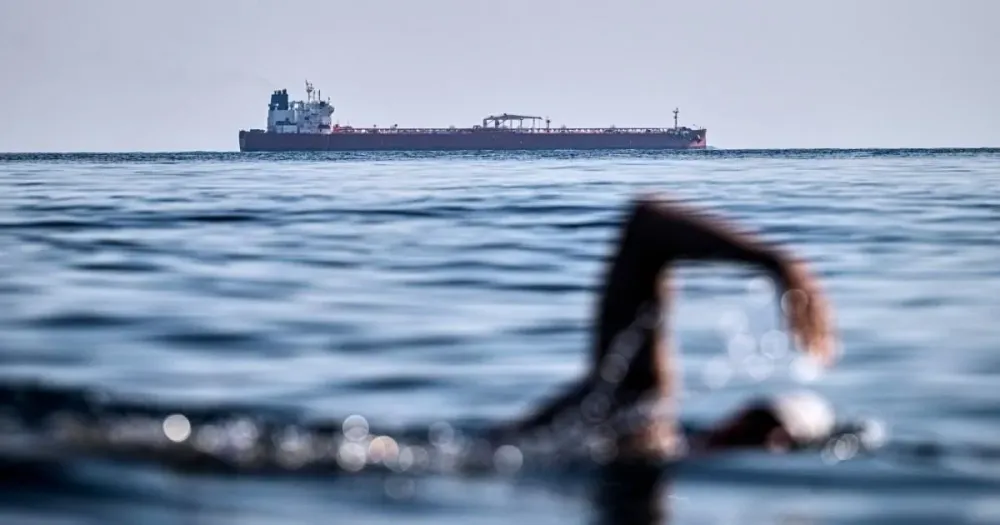
The Plymouth-born swimmer began at the Musandam Peninsula, at the strait's southern tip, and ended by rounding the Cape of Hormuz. His equipment consisted of swimming trunks, goggles and a UN-logo cap. According to the Associated Press, he spent about six and a half hours swimming, splitting the challenge into sections for safety.
Pugh said a tanker was hit a few kilometers away only 30 minutes into his swim. "The explosions rocked the sea around me," he said. "During the following days, I witnessed further attacks on commercial shipping and saw vessels engulfed in flames." His social media photographs showed a liquefied petroleum gas tanker burning off Oman's Musandam Peninsula, with smoke rising above the vessel.
Metro reported that Pugh is believed to be the first person to attempt a long-distance swim there since the US-Iran conflict began. The strait, a major route for Middle Eastern oil exports, has repeatedly closed during the US-Israel war with Iran. According to the AP, the US and Israel launched the war on February 28, 2026; before then, roughly one-fifth of traded oil traveled through the waterway.
The AP reported that Iran intensified attacks in the weeks before the swim against vessels it accused of taking unauthorized routes. Tankers have also hit sea mines laid by Tehran, including a ship carrying more than 2 million barrels of oil in October.
The environmental damage
Writing on his website, Pugh acknowledged the lives, families and homes destroyed by war, while arguing that harm to nature receives too little attention. He called the strait "far more than a vital shipping route" and "one of the most beautiful places I have ever visited". He described its mountains and fjords, coral reefs and mangrove forests, as well as the dolphins, sea turtles and dugongs living in its waters.
"Oil tankers, gas carriers and other merchant ships are being attacked, day after day. The environmental consequences of this war will last for generations," he said. "My message is simple: Stop the fighting. Open the Strait. Clean up the pollution."
Figures from Greenpeace and maritime tracking firm Kpler, reported by Skift, put the number of oil spills identified in and around the Gulf since the war began at more than 600 as of November 19. Greenpeace counted more than 160 attacks on oil tankers over that period.
Marine biologist Bernhard Riegl, who has spent more than 30 years studying the Gulf, warned that the damage could endure. He cited the Nowruz spills of 1983-85 during the Iran-Iraq war, which released 80 million gallons of crude. Research published in 2022 still found contamination from that oil in sediment on Saudi Arabia's Abu Ali Island. Separately, a 2020 study linked tar deposits on Qatari beaches to the first Gulf war.
Beach closures and a tourism downturn
Pollution has also disrupted access to the coast. Skift reported that an early-October strike on the tanker Gem No. 2 left a slick more than 22 miles long. On October 23, authorities closed every public beach in Ras Al Khaimah, Umm Al Quwain and along Sharjah's Gulf coast. Seven public and resort beaches in Ras Al Khaimah reopened on November 11.
By November, the conflict-linked slump in Gulf tourism had lasted nine months, according to Skift. CoStar's STR figures cited by the publication showed Dubai's October hotel occupancy at 68.4%, down from 84.9% a year earlier. In Ras Al Khaimah, occupancy declined to 71.5% from 87.9%.
Swimming and diplomatic pressure
Pugh has made swims in threatened ecosystems a recurring part of his environmental advocacy. He became the first person to complete a long-distance swim in each of the world's oceans and the first athlete to swim across the North Pole. In 2023, he swam the Hudson River's full 315 miles (507 km).
His foundation credits his campaigns with helping secure official agreements covering more than 3.5 million square kilometers of protected ocean. The combination of endurance swimming and political outreach has been dubbed "Speedo diplomacy".
Earlier in November, Foreign Secretary Ed Miliband called for an "all-out diplomatic effort" to end the war and fully reopen the strait. He said moving beyond the "no war, no peace" stalemate was essential, warning that it was causing "deep economic pain".