Broad losses across London stocks
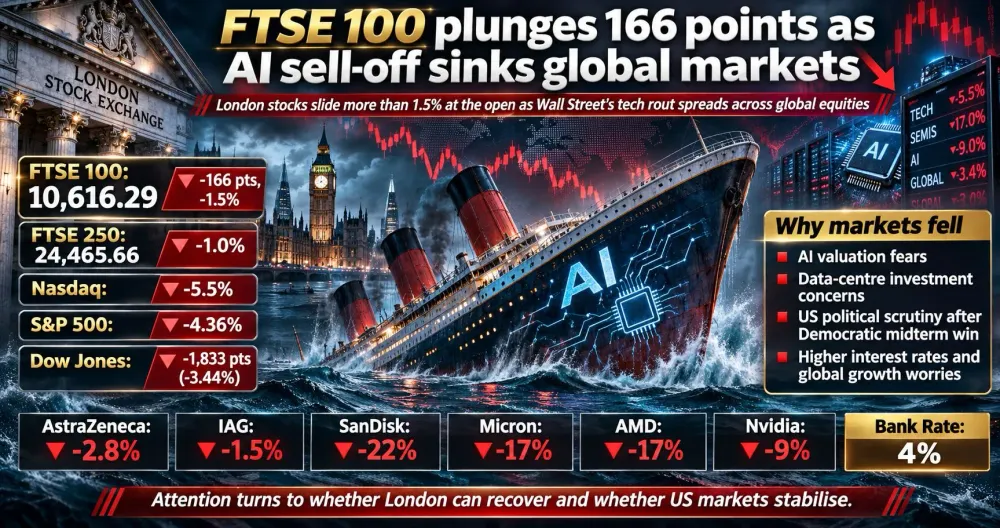
Most FTSE 100 stocks fell at Friday's open, while the FTSE 250 lost 1% to 24,465.66. The retreat extended a volatile Thursday session: the FTSE 100 had climbed toward 10,950 before reversing to close at 10,782.66.
AstraZeneca declined 2.8%, putting it among the FTSE 100's biggest losers. British Airways parent International Airlines Group (IAG) fell 1.5% after missing profit forecasts and signaling a small annual reduction in capacity.
The selling reached financial companies, industrial businesses and consumer-facing stocks. Although major technology companies account for relatively little of the FTSE 100 compared with US indexes, London's market was caught in the broader pullback in investor sentiment.
UK investors were also digesting the Bank of England's increase in interest rates to 4%, its first hike in more than three years, amid persistent inflation. Higher borrowing costs, alongside uncertainty about global growth, added to worries over earnings and stock valuations.
IAG profit misses expectations
IAG's third-quarter results showed lower operating profit despite higher revenue. RTÉ reported that operating profit before exceptional items totaled €1.73 billion, about 16% below the year-earlier figure and short of analysts' €1.81 billion consensus. Revenue rose 4.5% to €9.74 billion.
The airline group expects 2026 capacity to be slightly below 2025 levels. According to RTÉ, that would be its first annual capacity decline since 2022.
In its November 6 report, RTÉ also said IAG expected a full-year fuel bill of €8.9 billion and had hedged 45% of its exposure to fuel-price volatility for 2027. The company said bookings already covered 85% of its expected fourth-quarter seats.
AI concerns drive Wall Street's retreat
Thursday's US sell-off reflected renewed doubts about AI company valuations and the pace of future data center investment. Those concerns followed months of warnings that sharply rising AI-related share prices were vulnerable to shifts in investor expectations.
The Nasdaq Composite lost 5.5% on November 5. Investopedia reported that the decline left it more than 10% below its recent high, putting it in correction territory, and marked its worst day since the tariff-driven sell-off in April 2025. The S&P 500 fell 4.36%, while the Dow Jones Industrial Average shed 1,833 points, or 3.44%.
Chip and memory stocks bore particularly heavy losses. SanDisk dropped 22%; Micron Technology and Advanced Micro Devices each lost about 17%. Nvidia, a major beneficiary of AI computing investment, fell more than 9%. The Philadelphia Semiconductor Index slid 12%, according to Investopedia.
Another measure of market anxiety rose sharply: the Cboe Volatility Index, commonly called Wall Street's "fear gauge," jumped about 70%. Investopedia put its closing level at 28.18, the highest finish since March 30.
Data center politics adds uncertainty
The Democrats' US midterm election victory added a political dimension to investors' concerns about AI spending. Markets were weighing the possibility of closer scrutiny of technology companies and data center development under a Democratic-controlled Congress. Investopedia also linked part of the semiconductor sell-off to fears that Democratic wins in statehouses such as Texas and Georgia could delay data center permits and power approvals.
The election brought data center development directly before voters. CNBC, citing AdImpact, reported $173 million in nationwide advertising that was almost entirely negative as the issue became a major campaign topic. On November 3, voters considered 41 local data center measures; at least 10 communities approved bans or restrictions.
In Texas, Democratic Governor-elect Gina Hinojosa campaigned to pause new data center development, eliminate industry tax breaks and make developers pay their full electricity costs, CNBC reported. Republicans nevertheless retained control of the state Legislature.
Community opposition has focused on electricity use, infrastructure costs and environmental effects. Limits on new projects could affect demand for semiconductor equipment and the pace of AI infrastructure investment, but no immediate nationwide restrictions have been established.