Mainland tech losses deepen
The mainland's blue-chip CSI300 slipped 0.2 percent on Tuesday, leaving it down 13 percent since January. An AI-stock slump drove an 8.5 percent decline in October, its worst monthly performance since early 2016, according to Reuters and the Financial Times. The index has also lost about 15 percent over a record 12 consecutive weeks of declines.
Technology shares showed further weakness on Tuesday: the STAR Chip Index fell as much as 7 percent, reaching its lowest level since December 2025, and the AI index dropped more than 4 percent. Reuters and the Financial Times reported that the tech-heavy STAR 50 has shed around 40 percent since its June 2026 peak, wiping out approximately $480 billion in market value.
Shanghai's Composite Index finished at 3,608, a loss of 29 points, or 0.82 percent, with turnover of 810.83 billion yuan. The Shenzhen Component lost 133 points, or 1.21 percent, to finish at 10,876 on turnover of 892.6 billion yuan. The ChiNext fell 67 points, or 2.73 percent, to 2,391, with 446.45 billion yuan traded.
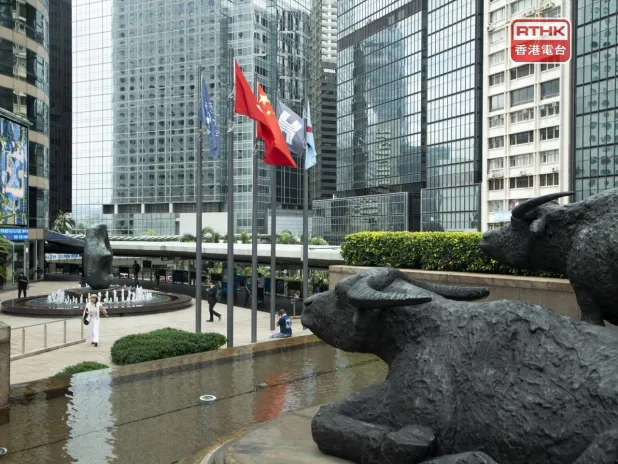
Hong Kong moved in the opposite direction. The Hang Seng added 132 points to reach 23,525, with turnover totaling HK$236.4 billion. The tech index finished at 3,867 after gaining 28 points, or 0.7 percent, while the China Enterprises Index advanced 36 points, or 0.5 percent, to 7,943.
Support measures draw mixed assessments
Regulators announced measures on Monday to help brokers, funds and companies finance stock purchases. The steps included central bank swap operations to fund buying and encouragement for share buybacks.
A separate effort would restrict new share supply. The Financial Times reported on November 3, citing three people familiar with the discussions, that China's securities regulator had instructed investment banks to pause initial public offerings and temporarily halted large sales by existing shareholders until markets recover. Reuters said the China Securities Regulatory Commission did not immediately respond to its request for comment.
Chen Jiande, general manager at Fujian Tianlang Asset Management, viewed the purchase-support measures as a repeat of the 2024 approach. Rather than encouraging buying, he said, they were giving investors an opportunity to sell. "These measures were below expectations," Chen said. "Many investors in battered tech shares are taking advantage of any rebound to rush out."
Thomas Mathews, Asia-Pacific head of markets at Capital Economics, also questioned their staying power. The measures were "unlikely to generate a lasting turnaround" without accompanying action that more directly tackles structural challenges, he told the Financial Times.
Economists at UBS led by Yu Song saw scope for support to increase. They interpreted the coordination among the three main regulators as a new phase of intervention that demonstrated a commitment to market stability. Still, they considered a full-scale repeat of earlier support unlikely: in their assessment, economic growth remained acceptable to policymakers, and the selloff did not signal a fresh weakening of fundamentals.
Citi's chief China economist, Yu Xiangrong, offered a different outlook. In a note reported by Reuters on November 3, he said support comparable in scale to the September 24, 2024 measures "may no longer be far off, as both real and nominal growth come under pressure."
Bond-fund pressure and Seoul losses
Apart from the stock-market decline, investors faced credit concerns surrounding state-backed conglomerate Zhuhai Huafa Group. Reuters reported on November 2 that the company had failed to repay two maturing trust products and was seeking extensions on some bank loans. Hedge fund manager iFund Asset Management said Huafa's liquidity squeeze "has transmitted to bond funds, with some funds forced to trade at a discount."
In Seoul, the Kospi finished at 5,648 after losing 210 points, or 3.59 percent. Chipmakers were among the decliners, with Samsung Electronics down 4.15 percent and SK Hynix down 5.03 percent.